


Beyond the Gig: How to Scale Your Freelance Side Hustle to a 6-Figure Business in 2025
We need to talk about the “trap.”
You know the one. You start a side hustle to gain freedom, but six months later, you’re working 50 hours a week at your day job and another 25 hours on nights and weekends. You aren’t building a business; you’ve simply created a second, more demanding job for yourself.
The “time-for-money” equation is the number one killer of freelance ambitions. If your income stops the moment you stop typing, designing, or consulting, you have hit a capacity ceiling.
But here is where it gets interesting. The landscape has shifted dramatically.
I have spent years analyzing how the top 1% of freelancers make this leap. They don’t work harder than you. They don’t have 28 hours in a day. They have simply mastered the art of scaling—building an ecosystem that operates independently of their direct labor.
In this guide, we are going to dismantle the “hustle harder” myth. We will walk through a data-backed roadmap to transition your side gig into a scalable, six-figure enterprise using systems, AI, and value-based pricing.
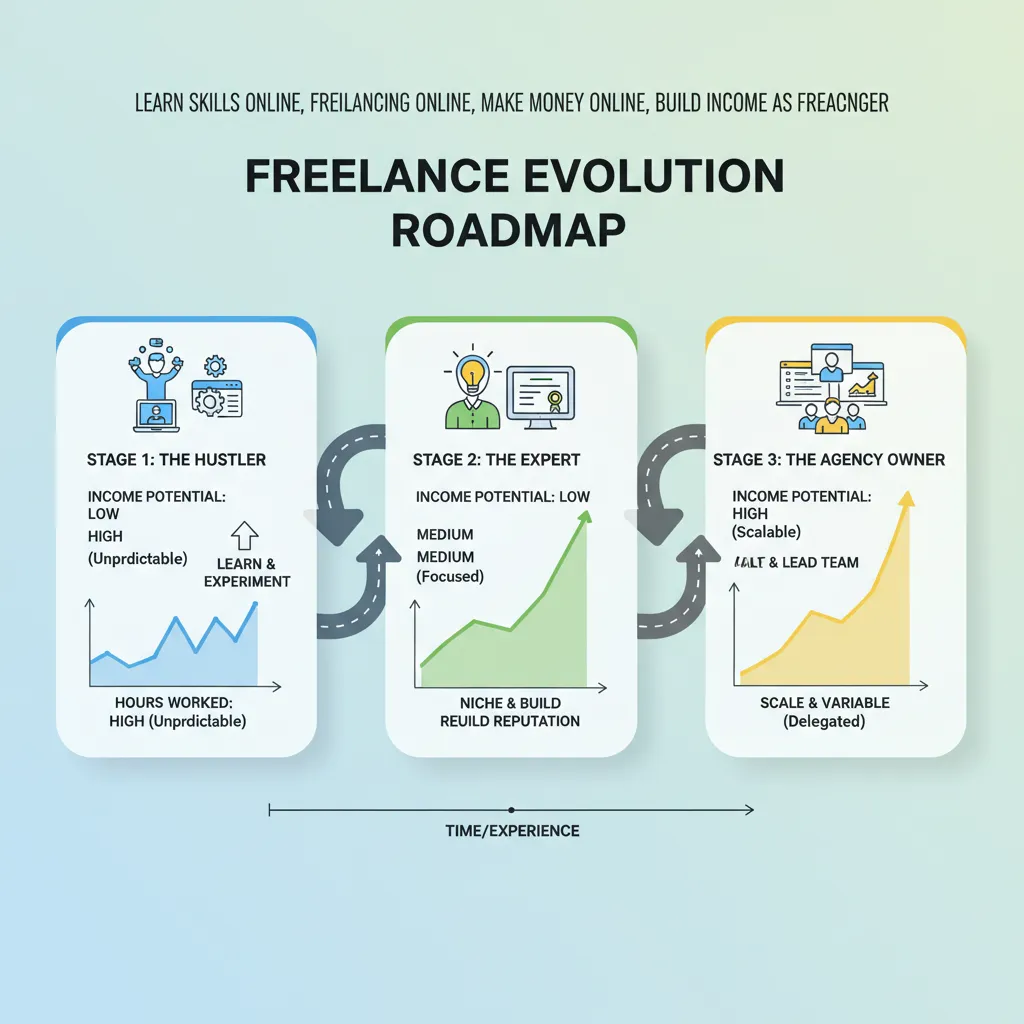
The Scaling Mindset: Why Most Side Hustlers Never Grow
Before we touch on tools or tax structures, we have to fix the software running in your head. Most freelancers are stuck in the “Maker” mindset. You take pride in doing the work yourself. You believe—wrongly—that no one can write that code or design that logo quite like you.
To scale, you must transition to the “Manager” mindset.
According to Upwork’s Future Work Index (April 2025), freelancers contributed a staggering $1.5 trillion to the U.S. economy recently. The individuals driving that number aren’t just “doing the work”; they are building assets.
Identifying the “Capacity Ceiling”
You hit the capacity ceiling when you can no longer accept new clients without sacrificing sleep or quality. For many, this happens around the $5,000/month mark. This is the danger zone. If you stay here, burnout is inevitable.
— Melissa Houston, Forbes Contributor (Nov 2024)
The goal isn’t to get more clients yet. The goal is to build a vessel that can hold more clients.
Step 1: Niche Specialization and Authority Building
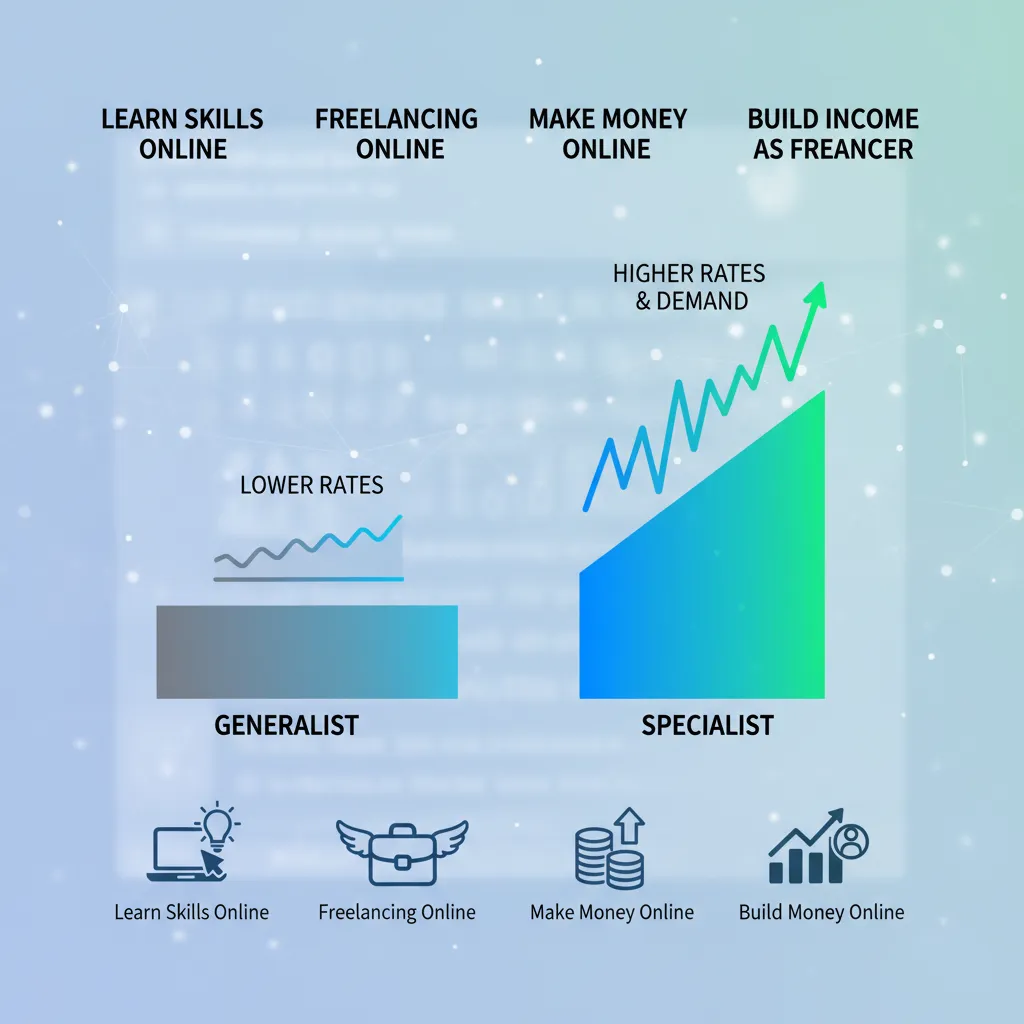
If you are a “Generalist Freelancer” in 2025, you are in trouble. With Generative AI handling basic tasks, the market for “generic content writing” or “basic graphic design” is collapsing.
To scale, you must narrow your focus to deepen your value. You cannot scale a business that tries to be everything to everyone.
Why Generalists Struggle in an AI World
Clients today don’t pay for hours; they pay for outcomes. A generalist competes on price. A specialist competes on expertise.
Data from Fiverr’s Freelance Economic Impact Report indicates that specialized services command rates 40-60% higher than generalist services. By picking a niche, you create a repeatable process (essential for scaling) rather than reinventing the wheel for every new client.
Case Study: High-Demand Niches for 2025
| Niche | Why It’s Scalable | Average Retainer |
|---|---|---|
| AI Consulting & Implementation | High demand, low supply. You set up the system once; the client maintains it. | $3,000 – $8,000/mo |
| Fractional CFO/CMO | Recurring revenue. High strategic value that doesn’t require 40 hours/week. | $4,000 – $10,000/mo |
| UX/UI for SaaS | Project-based with high barriers to entry for AI tools. | $5,000+ per project |
Step 2: Systematizing Success with SOPs and Tech
This is the unsexy part that makes you rich. Scaling requires documentation. If a process exists only in your head, you cannot delegate it. You cannot automate it. You are trapped.
Building Your “Business-in-a-Box”
You need to create Standard Operating Procedures (SOPs). This means documenting every single step of your workflow, from how you name files to how you onboard a client.
Real World Success: The Outsourcing Consultant
Marcus, a marketing consultant, hit a hard ceiling at $5k/month. He was spending 15 hours a week just on emails and onboarding.
The Pivot: Marcus spent a weekend recording Loom videos of his onboarding process. He turned these into a checklist. He then hired a virtual assistant to manage this specific workflow.
The Result: By removing himself from admin tasks, he doubled his client capacity and scaled to $15k/month within 90 days. (Source: Kabr2 Case Studies, 2025)
Essential 2025 Toolstack
In my experience, you don’t need a dozen subscriptions. You need a core “stack” that talks to each other.
- Project Management: Notion or ClickUp (The central brain).
- CRM: HubSpot or Dubsado (Automated client communication).
- AI Agents: Not just ChatGPT. Tools like AutoGPT or specialized agents that can perform research and draft emails autonomously.
Step 3: From Hourly Rates to Value-Based Pricing
You will never scale a side hustle to six figures charging $50 an hour. There simply aren’t enough hours.
The Math Behind the $100k Goal
Let’s look at the numbers. To make $100,000 a year:
- Hourly Model: At $50/hour, you need to bill 2,000 hours. That is a full-time job, not a scalable business.
- Value Model: You need 20 clients paying $5,000 for a specific package. Or 10 clients on a $850/mo retainer.
According to Fiverr, 49% of freelancers expected to raise their rates in late 2024/early 2025. If you haven’t, you are effectively taking a pay cut due to inflation.
How to Raise Rates Without Losing Clients
The secret is “Grandfathering.” You tell existing clients: “My rates are increasing to X on [Date] for new clients. As a loyal partner, I’m keeping you at your current rate for another 6 months.”
This builds loyalty while anchoring your higher value for the future. For new clients, you quote the new price immediately.
Step 4: Leveraging AI and Outsourcing
We are seeing a massive shift in how solo businesses operate. MBO Partners (2025) reports that 74% of freelancers now use Generative AI in their workflows, up from 65% in 2024.
But AI isn’t enough. You need human help, too.
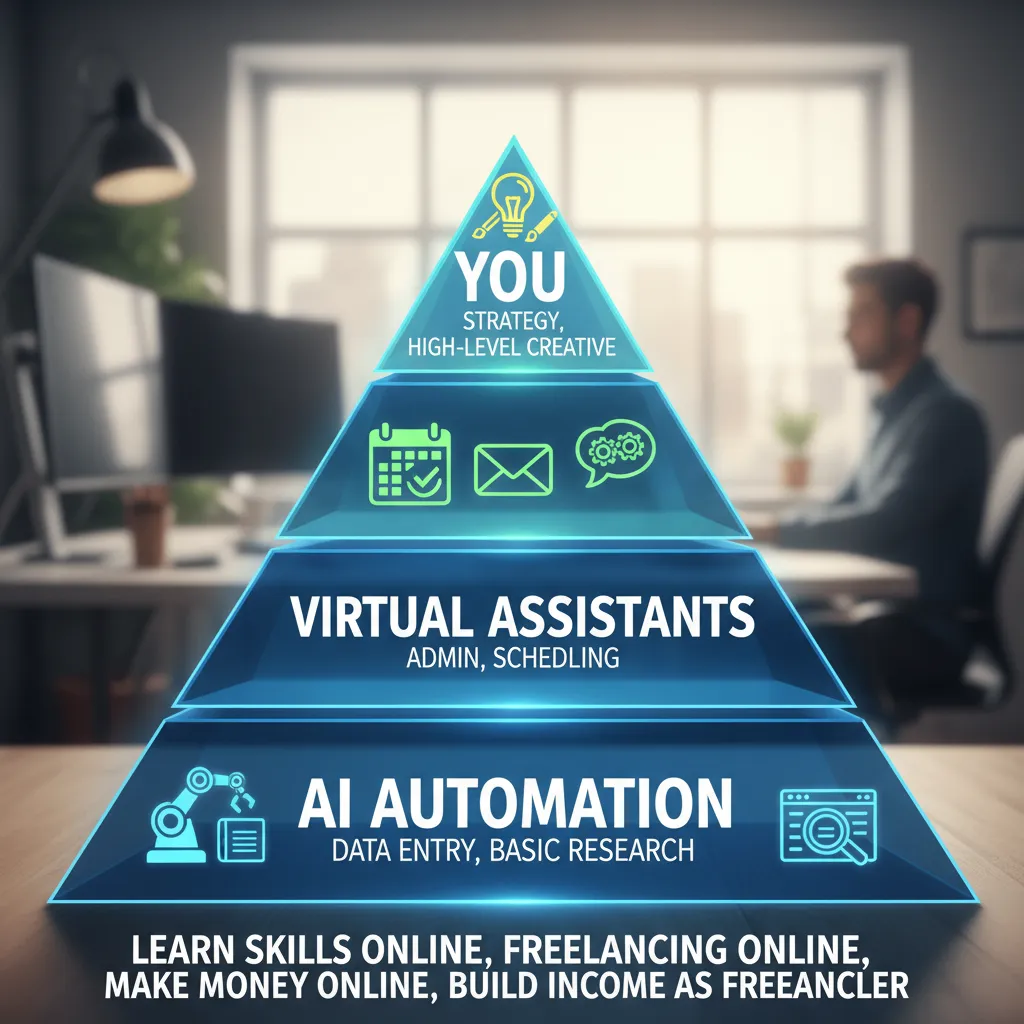
The 70/30 Rule
I recommend the 70/30 rule for scaling: Automate or outsource 70% of the work (admin, research, first drafts, invoicing). Keep the 30% that requires your unique “magic” (strategy, final polish, client relationships).
Miles Everson, CEO of MBO Partners, noted in a 2024 HumanCloud Podcast, “The independent workforce isn’t a fad… people are choosing a full-time independent career path.” Part of that path is acting like a CEO, which means hiring help.
Hiring Your First Virtual Assistant (VA)
Many freelancers are terrified of the cost. “I can’t afford to hire.” But let’s look at the math. If your billable rate is $100/hour, and you spend 5 hours a week scheduling meetings, that is costing you $500/week in lost potential revenue.
A skilled VA costs $10-$20/hour. By paying someone $100 to save you 5 hours, you net $400 in profit (assuming you use that time to bill clients).
Outsourcing Break-Even Calculator
Find out if hiring a VA makes financial sense for you.
Step 5: Diversifying Income Streams (Productizing Your Service)
The ultimate form of scaling is detaching your time from your money completely. This is where you move from “Service Provider” to “Product Owner.”
Creating Digital Assets
Look at your service. Which parts do you repeat constantly? Can you package that into a template, a course, or a toolkit?
Case Study: The Digital Asset Writer
Jessica, a freelance writer, was burning out writing articles for $200 each. She realized she was teaching every client the same SEO basics.
The Pivot: She created a “Digital Classroom” model—a set of templates and a video course on SEO writing. She sold this for $150.
The Result: She now sells 50 courses a month ($7,500) passively, while taking only select high-paying clients. Her income mix shifted from 100% active to 60% passive. (Source: Kabr2 Case Studies, 2025)
This aligns with what Abbie Lundberg, Editor-in-Chief at MIT Sloan Management Review, suggested in 2024: New models shouldn’t just be about outsourcing; they should prompt us to “fundamentally reconsider what the core business model looks like.”
Conclusion: Your 90-Day Scaling Roadmap
Scaling isn’t about a single magic trick. It’s about building a structure that supports weight. In 2025, with new business applications reaching 478,800 per month according to the U.S. Census Bureau, the competition is fierce. But the opportunity is massive.
Here is your immediate action plan:
- Days 1-30: Document your SOPs. Pick your niche. Raise your prices for new leads.
- Days 31-60: Implement a CRM and one AI agent to handle research or scheduling.
- Days 61-90: Hire your first contractor or VA to handle the 70% of low-value tasks.
You have a choice. You can keep hustling until you burn out, or you can build a business that works for you. The tools are there. The market is ready. The rest is up to you.
Frequently Asked Questions (FAQ)
When should I quit my job to go full-time freelance?
A common rule of thumb is to wait until your side hustle income matches 75% of your day job expenses for three consecutive months. Additionally, ensure you have 3-6 months of an emergency fund saved, as freelance income can be variable.
What are the most profitable freelance niches in 2025?
Based on current market data, AI implementation, cybersecurity consulting, fractional executive roles (CFO/CMO), and specialized blockchain development are among the highest-paying niches.
How do I automate my freelance business?
Start with the “low hanging fruit”: client onboarding and invoicing. Use tools like Dubsado or HoneyBook to automate contract signing and payment reminders. Use AI tools for content research and drafting emails.
Can a side hustle really reach $100k a year?
Absolutely. Data from SIA shows 5.6 million independents earn over $100k. However, hitting this number usually requires moving away from hourly billing to value-based pricing or retaining recurring clients.
How do I hire a virtual assistant for freelancing?
Start by identifying the tasks you hate doing. Then, use platforms like Upwork or specialized agencies to find talent. Create a clear SOP (video walkthrough) for the tasks you want them to do before you hire them to ensure a smooth handover.
