

15+ Freelance Portfolio Examples for Beginners (2025 Guide: No Experience Needed)
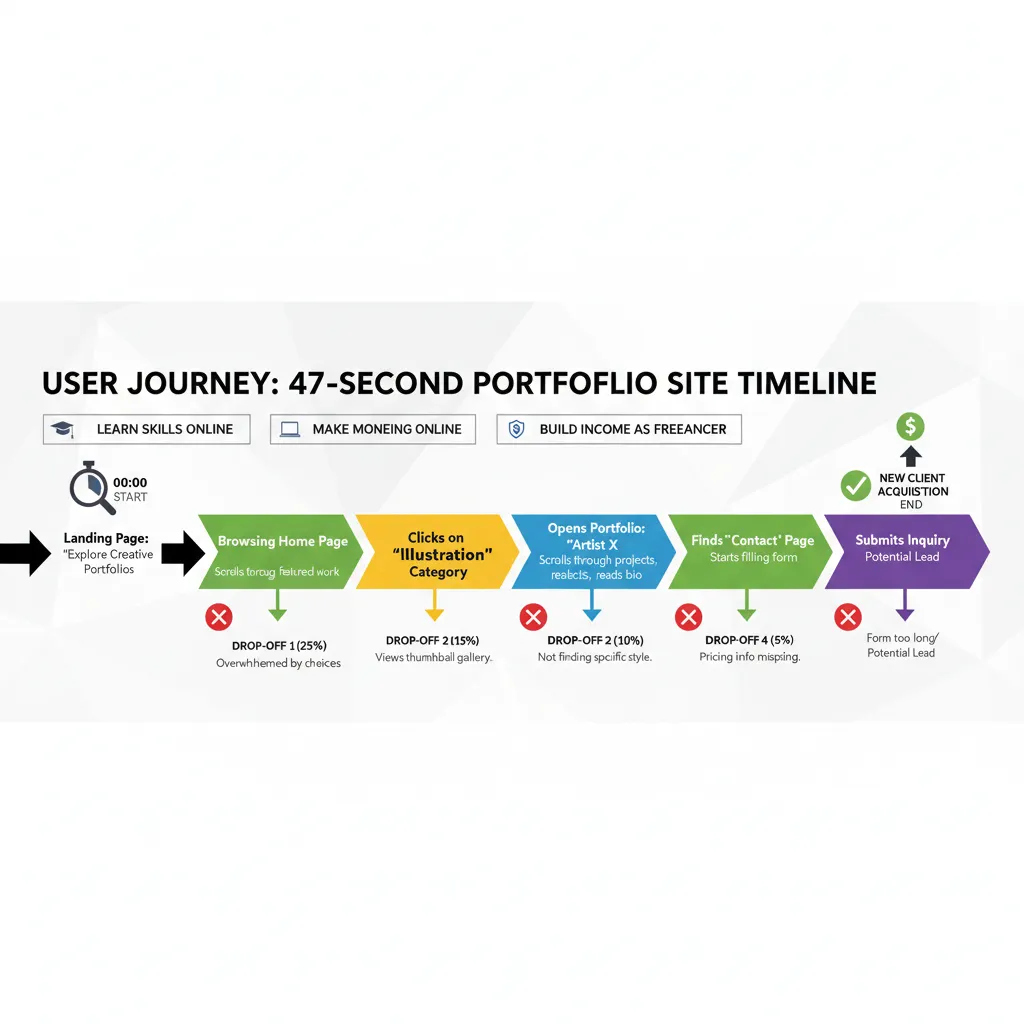
You have exactly 47 seconds.
That is not a random number I pulled out of thin air. According to a 2024 benchmark report by The Science Survey/Unbounce, human attention spans for digital content have dropped to just 47 seconds. That is all the time you have to convince a potential client to stop scrolling and start reading.
If you are reading this, you are likely stuck in the classic freelancer’s paradox: You need a portfolio to get a job, but you need a job to build a portfolio. It feels like a rigged game. I’ve been there, staring at a blank screen, wondering how to sell “potential” when clients want “proof.”
But here is the good news: In 2025, you do not need paid client work to build a world-class portfolio.
With the freelance economy now contributing $1.27 trillion to the U.S. economy annually, the barrier to entry has shifted. Clients no longer care about who you worked for; they care about what you can do.
In this guide, we aren’t just going to look at pretty pictures. I’m going to show you how to build a high-converting portfolio from scratch using “Spec Work,” personal projects, and the specific strategies used by the top 1% of freelancers.
Why Most Beginner Portfolios Fail (And How to Fix Yours)
Before we dive into the examples, we need to address the elephant in the room. Most beginner portfolios are actually just galleries. They are lists of links or images without context.
If you simply upload a logo you designed or a blog post you wrote, you are forcing the client to do the heavy lifting. You are asking them to guess what the goal was, what constraints you faced, and how you solved the problem.
To fix this, you need to shift from a “Deliverable Mindset” to a “Case Study Mindset.”
According to Matomo’s 2024 Analytics Report, using portfolio case studies increases B2B lead generation by over 65%. Why? Because case studies tell a story. They show your process, not just the result.
The “Case Study” Formula
Every example in your portfolio, even if it’s a fake project, should follow this structure:
- The Problem: What was the business trying to achieve?
- The Solution: How did you approach it?
- The Result: What was the outcome? (Use data if possible).
How to Build a Portfolio with Zero Clients
This is the number one question I get: “What do I put in my portfolio if I have never had a client?”
You create the work yourself. This is called Spec Work (Speculative Work). In the eyes of a hiring manager, a well-executed spec project is often better than a mediocre real client project because it shows your unfiltered creativity.
“99% of employers plan to hire freelancers in 2025 after recent layoffs, prioritizing skills verification over employment history.”
— Source: Fiverr Economic Impact Report 2024
Method 1: The “Mock Client” Project
Pick a brand you love—or better yet, a local business with a terrible website or brochure. Redesign it. Rewrite their copy. Build a new landing page for them.
Crucial Step: Clearly label this as “Concept Work” or “Speculative Project.” Do not pretend you were hired by Nike if you weren’t. Honesty builds trust.
Method 2: Passion Projects
Do you love hiking? Build a blog about hiking gear. Are you into crypto? Design a dashboard for a crypto wallet.
This approach works incredibly well because your enthusiasm shines through. According to Upwork’s September 2024 report, 52% of Gen Z professionals are using personal passion projects to launch their freelance careers.
Freelance Portfolio Examples by Niche
Let’s get specific. A writer’s portfolio should not look like a web developer’s portfolio. Here is how to structure yours based on your industry.
1. Freelance Writing Portfolio Examples
The Challenge: Writing is text-heavy. It can look boring visually.
The Solution: Use “Clips” and social proof. Don’t just paste the text on your site. Take a screenshot of the article as it appeared live (or a mockup of how it would appear).
Example Strategy: The Niche Specialist
Concept: Instead of being a “General Writer,” be a “Fintech Writer” or a “Health & Wellness Writer.”
Real-World Proof: Anna Burgess Yang, a freelance writer, increased her income by 16% in 2024 specifically by focusing her portfolio on the Fintech niche. She didn’t just show writing; she showed she understood the industry language.
What to include:
- Headline: “I write blog posts that rank on page 1.”
- Sample 1: A long-form SEO guide (Spec work: Write a guide for a tool you use, like Trello or Notion).
- Sample 2: An email newsletter sequence (Spec work: Write a welcome sequence for a local gym).
- Sample 3: A landing page copy rewrite (Spec work: Rewrite the homepage of a SaaS product).
2. Graphic Design Portfolio Examples
The Challenge: Showing process, not just pretty pixels.
The Solution: Show the “Before” and “After.”
Mockups are your best friend here. Don’t just upload a flat JPEG of a logo. Place that logo on a business card, a storefront signage mockup, or a t-shirt. Context creates perceived value.
Beginner Project Idea: The “Re-Brand.” Find a local non-profit with a dated logo. creating a completely new visual identity for them. Document your sketches, your color choices (Navy #0a192f is trending in 2025, by the way), and the final application.

3. Web Development Portfolio Examples
The Challenge: Code is invisible. Clients want to see what the code does.
The Solution: Clean documentation and “The Stack.”
According to Exploding Topics (Feb 2024), web design remains the highest-demand freelance service globally. However, competition is fierce.
Beginner Project Idea: Build a “pricing calculator” for a service business. It involves logic, UI design, and solves a specific problem. Embed this directly on your portfolio site.
4. Digital Marketing & SEO Portfolio Examples
The Challenge: Marketing is abstract until results come in.
The Solution: Visualized Data.
You need charts. Even if you don’t have client data, you can audit a site. Use a tool like Ubersuggest or Ahrefs (free versions) to audit a popular website. Create a PDF report outlining their SEO mistakes and how you would fix them.
Case Study Verification: Freelancer Harsh Mishra used thumbnail design case studies to land high-profile YouTube clients. He didn’t just say “I design thumbnails.” He showed data on how his designs improved Click-Through Rates (CTR). (Source: Fueler.io 2025).
5 Best Portfolio Platforms for Beginners (2025 Edition)
You do not need to spend weeks coding a custom website from scratch. In fact, doing so might hurt you if the UX is poor. Remember the 47-second rule? You need speed.
Here are the platforms dominating the industry right now:
1. Fueler (Best for “Proof of Work”)
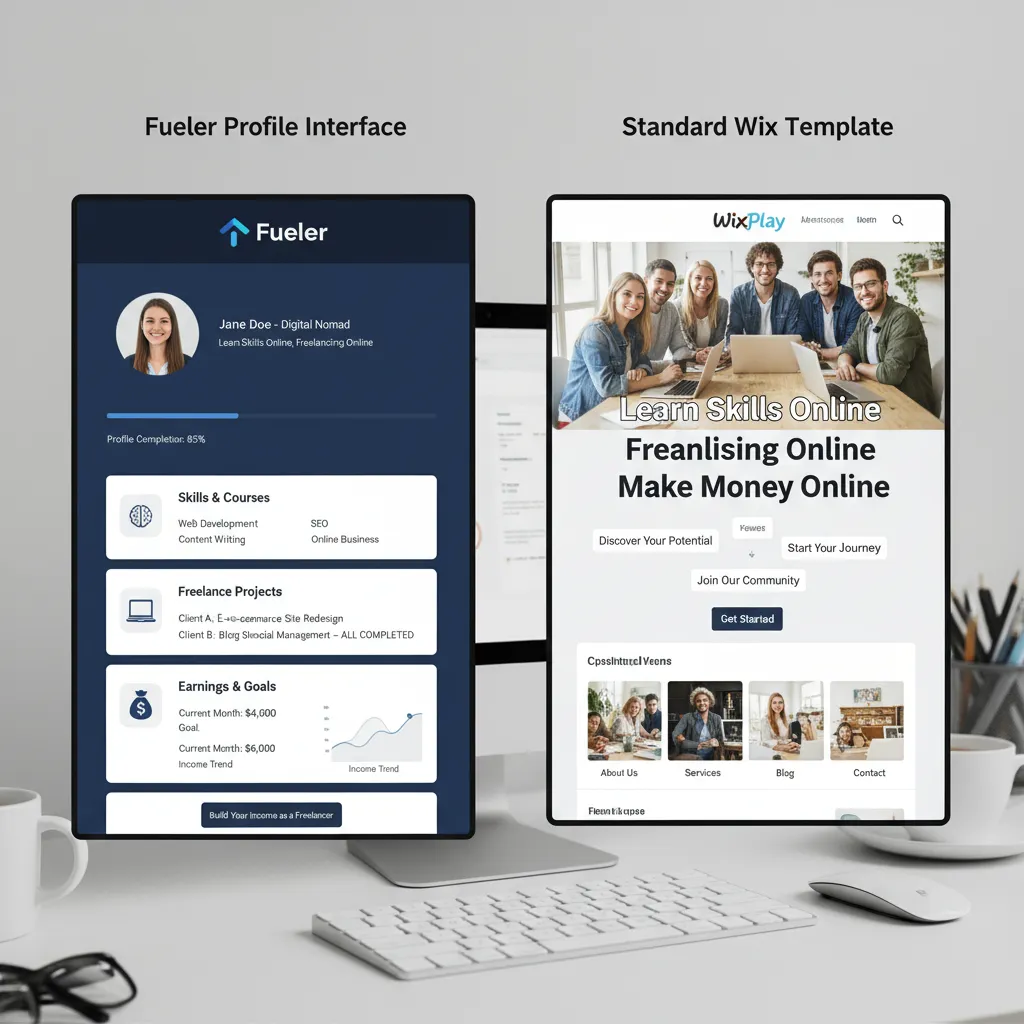
Fueler has gained massive traction because it focuses on case studies rather than just visuals. It allows you to document your “Proof of Work” in a way that developers and marketers love. With over 60% of portfolio views now occurring on mobile, Fueler’s mobile-first design is a huge advantage.
2. Contra (The Industry Standard)
Contra is completely fee-free for freelancers and acts as both a portfolio and a payment platform. It creates a sleek, professional “Independent” profile that looks good instantly.
3. Wix or Squarespace (For Creative Control)
If you want full control over the design, these builders are powerful. However, they cost money. If you are starting with $0 budget, this might not be day one choice.
4. Notion (The Minimalist Choice)
Believe it or not, many successful freelancers manage their portfolios in Notion. It is clean, fast, and shows you are organized. It works exceptionally well for writers and project managers.
The Anatomy of a High-Converting Portfolio Page
Regardless of the platform, every portfolio page needs these three elements to convert visitors into paying clients.
1. The Hero Section
This is the top of your page. It must answer three questions instantly:
- Who are you?
- What do you do?
- Why should I care?
Bad: “Hello, I’m John. Welcome to my world.”
Good: “I build high-speed Shopify stores for fashion brands. Helping you scale from $0 to $10k/month.”
2. The “Problem-Solution” Framework
As we discussed, present your work as solutions to problems. “I wrote 5 blog posts” is a feature. “I increased organic traffic by 20% through content strategy” is a benefit.
3. The Strategic CTA (Call to Action)
Do not leave the client hanging. Tell them what to do next. The median website conversion rate is 6.6% in 2024. To hit this, you need clear instructions.
Instead of “Contact Me,” try “Book a Free 15-Minute Strategy Call” or “Get a Free Audit.”
Common Mistakes That Kill Conversions
I have reviewed hundreds of portfolios. Here are the red flags that make me click “back” immediately:
- Broken Links: Nothing screams “unprofessional” louder than a 404 error on your own work samples.
- Slow Loading Speeds: If your high-res images take 5 seconds to load, you have already lost the client (remember the 47-second stat?). Use tools like TinyPNG to compress your images.
- Being a “Jack of All Trades”: “I do graphic design, singing, dog walking, and PHP coding.” No. Pick one lane for your portfolio. If you have multiple skills, create separate landing pages.
FAQ: Freelance Portfolios for Beginners
Do I really need a website, or is a PDF enough?
While a PDF is better than nothing, a website is dynamic and searchable. A PDF cannot be indexed by Google. Plus, 60% of clients review portfolios on mobile, and pinching and zooming a PDF is a terrible user experience. A responsive website is professional.
Should I include my rates in my portfolio?
For beginners, I usually advise against it. Your goal is to start a conversation. Once you get them on a call, you can sell the value. However, listing a “Starting at” price can filter out low-ball clients if you are getting too many bad leads. Note that the average global freelance rate for marketing is currently $101/hour, so don’t undervalue yourself.
Can I use Upwork as my portfolio?
You can, and Upwork is a high-authority domain. However, you do not own that real estate. Upwork can ban your account or change their algorithm. Use Upwork to get clients, but direct them to your personal site (Fueler/Contra/WordPress) whenever possible to build your own brand equity.
How many projects do I need to launch?
You only need three solid case studies. Three examples prove a pattern. Anything more than six can actually be overwhelming. Quality always beats quantity.
Conclusion: Start Imperfectly
Building a portfolio can feel paralyzing. You look at the pros with their award-winning sites and feel like you can’t compete. But remember, every single one of those experts started with zero clients and a blank page.
The market is growing. With the freelance platform market expected to reach $14.17 billion by 2029, there is plenty of room for you.
Your portfolio does not need to be a masterpiece of art; it needs to be a masterpiece of communication. It needs to tell a client: “I understand your problem, and I can fix it.”
So, here is your homework for today: Pick one “Mock Client.” Create one case study. Put it online. That is how you go from “beginner” to “booked.”
