


How to Pick a Profitable Digital Niche in 2025: The Data-Driven Blueprint
You’ve probably heard the horror stories. Someone spends six months pouring their heart and soul into a blog about “underwater basket weaving for left-handed millennials,” only to realize zero people are searching for it, and even fewer want to pay for it.
It’s heartbreaking, but it’s common. In my years of working with digital entrepreneurs, I’ve seen that 95% of businesses fail within the first six months, often because they skipped the most critical step: strategic niche selection.
But here is the silver lining. The opportunities are massive if you get this right. According to Goldman Sachs, the global creator economy reached $205.25 billion in 2024 and is projected to hit nearly half a trillion dollars ($480 billion) by 2027. The money is there. The audience is there. The only missing piece is a validated strategy.
In this guide, I’m not just going to give you a list of “hot topics.” I’m going to walk you through the 2025 Hybrid Niche Framework—a method that combines human intuition with AI data validation to virtually guarantee you pick a winner.

What Makes a Digital Niche “Profitable” in 2025?
Before we start brainstorming, we need to redefine what “profitable” means. In the old days (think 2018), you could slap some ads on a travel blog and retire. Today, the landscape is different.
The Three Pillars: Demand, Competition, and Monetization
To succeed now, your niche must pass a strict tripartite test. If it fails one pillar, the structure collapses.
- High Demand (Search Volume): Are people actually looking for this?
- Manageable Competition (Keyword Difficulty): Can you actually rank for it?
- Deep Monetization Potential: Can you sell something beyond just ad space?
According to The Leap, a staggering 67% of monetized creators now sell their own products rather than relying solely on ads. This is a crucial shift. If your niche only works with AdSense, you are leaving money on the table.
The YMYL and E-E-A-T Factor
If you are aiming for Google rankings—and you should be—you must understand YMYL (Your Money Your Life). Google is incredibly strict about niches that impact people’s health, finances, or safety.
In my opinion, if you don’t have genuine expertise (or access to experts) in sectors like medical advice or investment, steer clear. Google’s E-E-A-T (Experience, Expertise, Authoritativeness, and Trustworthiness) guidelines are not suggestions; they are gatekeepers.
“Google only loves you when everyone else loves you first.”
— Wendy Piersall, Author & Artist (Cited via Sheikh Shadi, July 2025)
Step 1: Brainstorming Using the Passion-Profit Matrix
The biggest mistake I see people make is choosing a niche solely based on a spreadsheet. They see “high CPC” (Cost Per Click) in the insurance niche and dive in, only to burn out three weeks later because they find insurance boring.
Identifying Your “Unfair Advantage”
You need a niche where you can sustain content production for years. This is where the Passion Economy meets the Creator Economy. But passion alone isn’t enough; you need an “unfair advantage.”
Ask yourself: What do I know better than the average person? Where have I achieved results that others envy?
Rebecca Lieb, a renowned Digital Strategist, put it perfectly: “Content is the atomic particle of all digital marketing.” (Capsicum Mediaworks, 2025). If you can’t produce the atomic particles (content) because you hate the topic, your marketing universe never forms.
Using AI Agents for Niche Discovery
Here is where 2025 tech comes in. You don’t have to brainstorm alone. With 86% of global creators now using generative AI tools (Adobe, Oct 2025), you are at a disadvantage if you don’t.
Use an AI agent (like ChatGPT or Claude) to cross-reference your interests with market trends. Prompt it with: “I have experience in [Skill A] and [Skill B]. Generate 10 micro-niche ideas that combine these skills with high-ticket affiliate potential.”
Step 2: Validating Market Demand with Hard Data
Once you have an idea, you must validate it. We don’t guess; we test.
Keyword Volume vs. Difficulty: The Sweet Spot
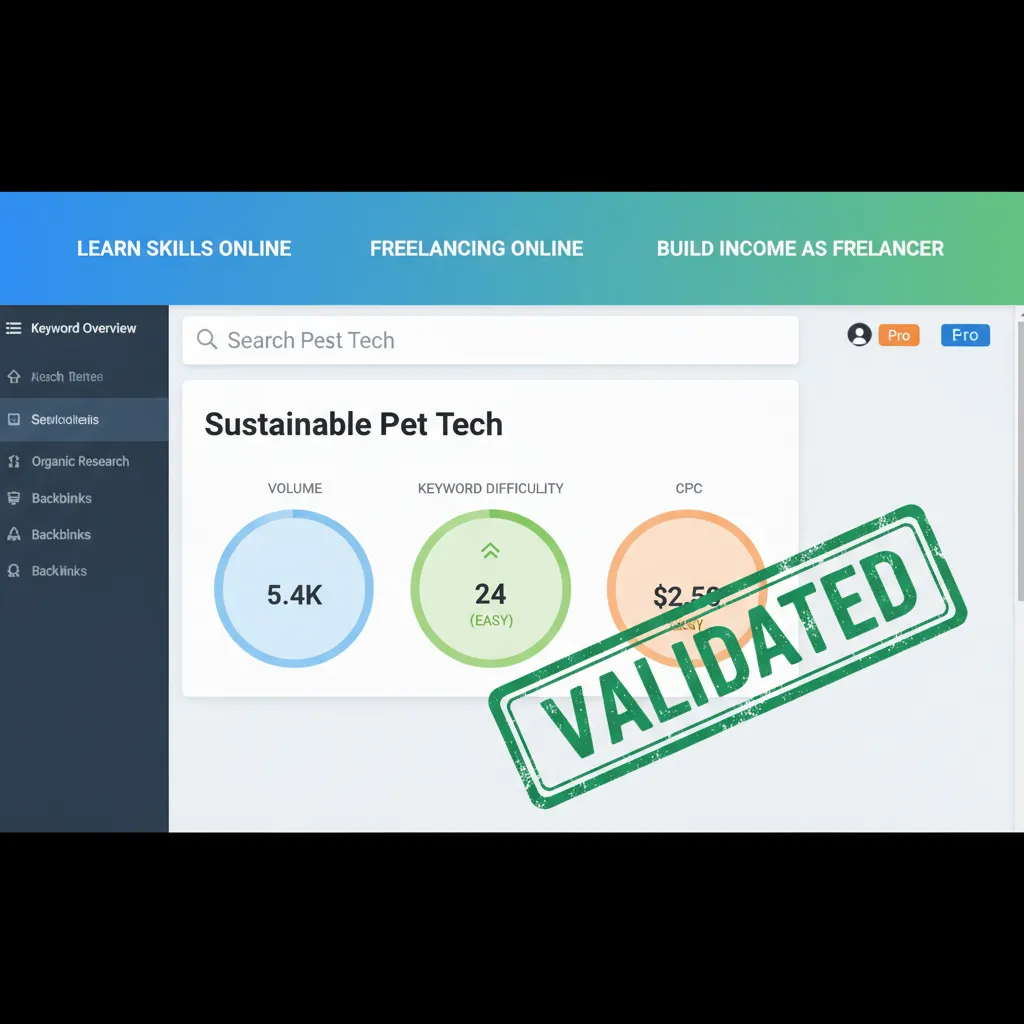
You are looking for the “Goldilocks” zone. You want keywords with decent search volume (1,000+ monthly searches) but low-to-medium Keyword Difficulty (KD).
Search advertising reached a massive $202.4 billion in volume in 2024 according to WordStream. This means advertisers are spending big, but it also means competition is fierce. Look for “long-tail variations” of your niche. Instead of “Fitness,” try “Post-partum yoga for working moms.”
The “Generative Engine Optimization” (GEO) Factor
This is the part most guides miss. In 2025, you aren’t just optimizing for Google’s search bar; you are optimizing for AI answers.
Brian Corish from Accenture Interactive noted, “2025 is the year when AI goes from saying stuff to doing stuff through the rise of agents” (Digital Marketing Institute, April 2025).
When someone asks ChatGPT, “What is the best equipment for a home gym?”, you want your niche site to be the source the AI cites. This requires deep, authoritative content that answers questions directly.
Step 3: Monetization Analysis (Beyond AdSense)
AdSense is great for passive income, but it requires massive traffic. The real profitability lies in targeted monetization.
High-Ticket Affiliate vs. Digital Products
I always advise clients to look for niches with “High-Ticket” potential. Selling one $2,000 course as an affiliate (with a 40% commission) is easier than getting 50,000 people to click a $0.50 ad.
Consider the case of Easily Excel. Founder Senna Brennan turned a seemingly dry Microsoft Excel niche into a 6-figure business by creating specific, high-value resources rather than just generic tutorials (Thinkific, 2025). That is the power of a specific product focus.
(Use this logic to score your idea)
- Passion Score (1-10): How much do you like it?
- Expertise Score (1-10): Do you know more than a beginner?
- Market Size (1-10): Are there at least 10k monthly searches for the main topic?
- Product Potential (1-10): Can you create a course or ebook?
Total Score > 30? You have a winner. Score < 20? Back to the drawing board.
The 5 Most Profitable Digital Niches for 2025
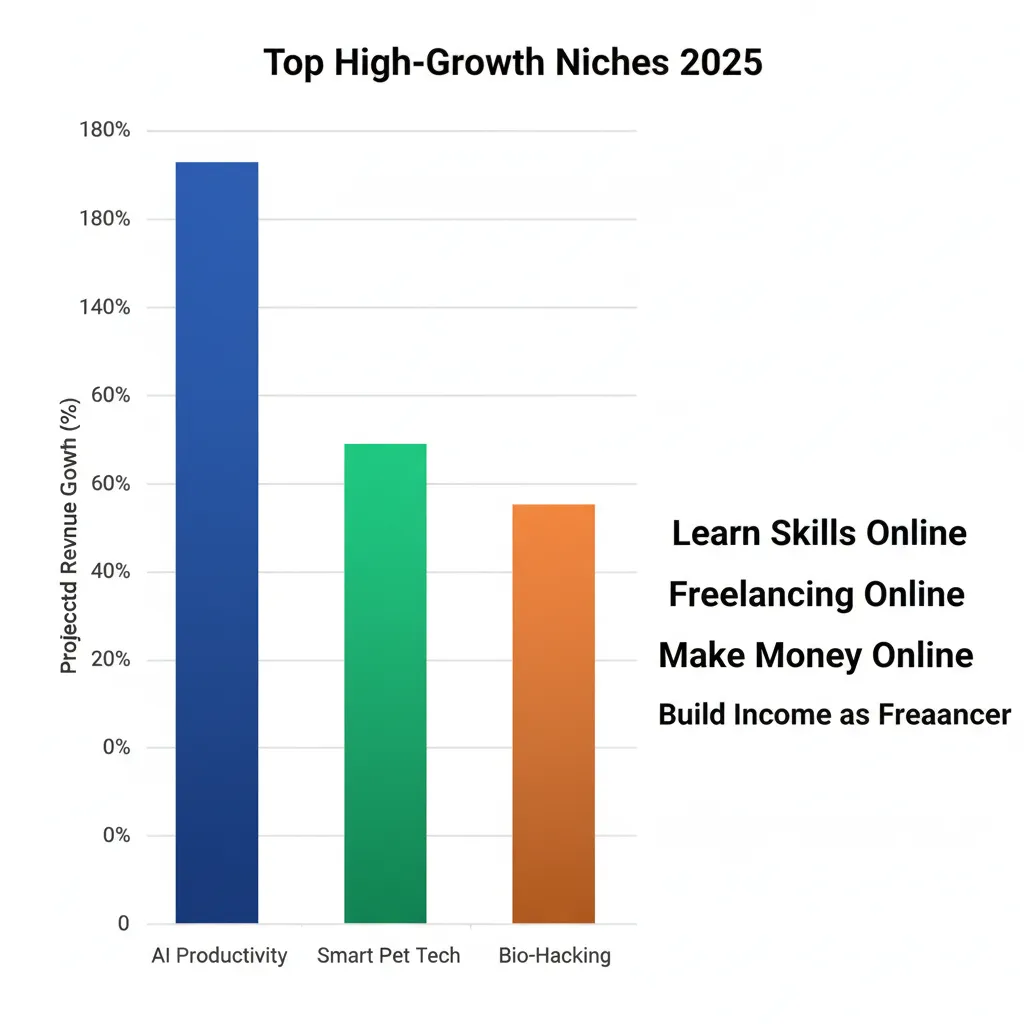
Based on the current trajectory of the market and the 17.6% CAGR growth in digital marketing, these are the sectors showing the highest promise.
1. AI-Enhanced Productivity (SaaS/B2B)
Businesses are drowning in AI tools and don’t know how to use them. A niche focused on “AI workflows for Real Estate Agents” or “Automated Customer Service for Small Biz” is gold right now.
2. Sustainable Bio-Hacking & Wellness
The personal development industry is valued at $43.77 billion and growing (Thinkific, Nov 2025). However, the sub-niche of “Gut Health Tech” and “Data-Driven Sleep Optimization” is where the high-paying audience lives.
3. Smart Pet Technology
People love their pets like children. The pet care industry is worth a massive $259.37 billion according to AffiliateWP. The growth area? Smart collars, automated feeders, and health-tracking apps for dogs and cats.
4. Micro-SaaS for the Creator Economy
Remember that “gold rush” analogy? Selling shovels is profitable. Building small software tools (Micro-SaaS) that help YouTubers or TikTokers manage their business is incredibly lucrative.
5. Ethically-Sourced E-Commerce
Consumers are becoming more conscious. Niche sites that review and curate “Fair Trade Home Goods” or “Plastic-Free Kitchenware” are seeing higher conversion rates because they align with buyer values.
How to “De-Risk” Your Choice
Even with all this data, there is risk. The best way to mitigate it is to look at Market Saturation differently.
Don’t fear competition; fear indifference. If there are competitors, it means there is money. Your goal is to find a “Competitor Keyword Gap.”
A smart strategy is to look at what the big players are missing. Most competitors miss “Generative Engine Optimization (GEO)” and “Niche selection for AI Agents.” If you start a blog today that is specifically formatted for AI answers (bullet points, clear data tables, direct answers), you can leapfrog established competitors who are stuck in 2020 SEO tactics.
Niche influencers (those under 100k followers) deliver 6x higher engagement than mega-influencers (HubSpot, May 2025). This proves you don’t need to be huge; you just need to be highly relevant to a small group.
Frequently Asked Questions
Use tools like ChatGPT or Perplexity to analyze search intent. Ask the AI to simulate a buyer persona for your niche and list their top 10 pain points. If the pain points are acute and expensive to solve, you have a valid niche.
The three non-negotiable criteria are: 1) High Demand (Search Volume), 2) Low-to-Medium Competition (Keyword Difficulty), and 3) High Monetization Potential (Affiliate/Products).
Absolutely not. While broad niches are saturated, micro-niches are thriving. With the creator economy growing to nearly half a trillion dollars by 2027, the market is expanding, not shrinking.
Typically, it takes 6-12 months to see significant traction with SEO. However, utilizing social media and “Generative Engine Optimization” can speed this up. One case study showed a creator hitting 6-figures by their 3rd launch by switching to a specific template niche.
Conclusion: The “Hybrid” Future is Yours
Picking a profitable digital niche in 2025 isn’t about guessing what’s cool. It’s a scientific process of balancing your personal “unfair advantage” with cold, hard market data.
We’ve covered the explosive growth of the $205 billion creator economy, the necessity of checking your idea against the “Passion-Profit Matrix,” and the emerging importance of optimizing for AI search engines.
Your next steps are clear:
- List your top 5 interests.
- Run them through a keyword tool to check volume and difficulty.
- Identify one specific problem in that niche you can solve better than anyone else.
- Start creating content that serves both humans and AI agents.
The digital landscape is vast, but with a laser-focused niche, you don’t need to conquer the whole world—you just need to conquer your corner of it.
