


Mastering Client Management: How to Handle Difficult Freelance Clients (2025 Guide)
You didn’t start freelancing to become a debt collector, a therapist, or a mind reader. You started because you have a skill and you want the freedom to use it.
But here is the harsh reality of the 2025 landscape: according to fresh data from Flexable.work, 58% of freelancers across diverse sectors will face non-payment or delayed payments this year, resulting in a staggering annual industry loss of $15 billion. If you feel like clients are becoming more demanding while paying less attention to boundaries, you aren’t imagining it.
In my decade of navigating the gig economy—from the early days of content mills to high-ticket consulting—I’ve realized that “difficult” clients aren’t just a nuisance; they are the single biggest threat to your business longevity.
This guide isn’t about “the customer is always right.” It is about the Guardrail Framework: a system designed to protect your income, your sanity, and your professional reputation. We will cover everything from spotting red flags during onboarding to the legal anatomy of firing a client without getting sued.

The Psychology of the “Difficult” Client: Personas & Red Flags
Before we can handle them, we have to identify them. Difficult clients rarely show their true colors in the first email. However, looking back at my own portfolio of headaches, there were always signs.
In 2025, we are seeing three distinct archetypes dominate the “problem client” roster:
1. The Ghoster: Sudden Silence
This client is responsive until the invoice lands. A 2024 case study highlighted by Dr. Pen revealed a disturbing trend where long-term clients vanish overnight, leaving freelancers with completed work and empty pockets. Ghosting isn’t just rude; it’s theft of time.
2. The Scope-Creeper: “Just One More Thing”
They start with a logo design. Then they ask for a business card. Then a social media banner. Suddenly, you’ve done 15 hours of unbilled work. Scope creep is insidious because it often comes wrapped in compliments: “You’re so good at this, could you just quickly look at…”
3. The Micromanager: The “Expert” in Disguise
According to a 2024 report by Carmine Mastropierro, 68% of clients leave because they perceive an attitude of indifference. Ironically, micromanagers often create this indifference by stripping the freelancer of autonomy. They hire you for your expertise but insist on directing your every mouse click.
🚨 Client Red Flag Calculator
Check the boxes that apply to your prospective client:
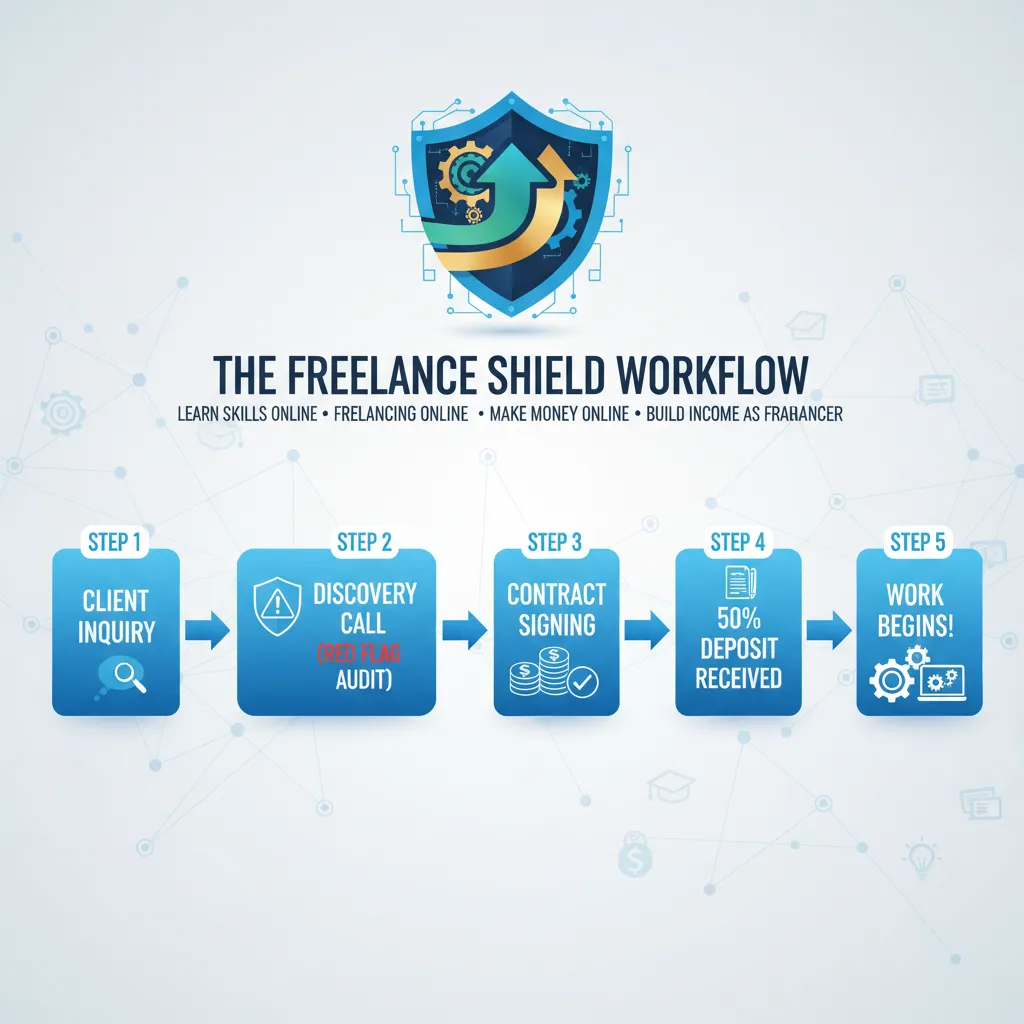
Proactive Prevention: Building Your "Freelance Shield"
You cannot fix a toxic personality, but you can build a fortress that makes it impossible for them to damage your business. The foundation of this fortress is documentation.
The Ironclad Contract: Essential Clauses for 2025
It shocks me that, according to the CREATe UK Freelance Journalist Report (March 2024), 40% of freelance journalists still undertake work without any contract at all. This is financial suicide.
To handle difficult clients, your contract must include:
- Detailed Scope of Work (SOW): Define exactly what is included and, more importantly, what is not included.
- Revision Limits: Standardize this to two rounds. Anything beyond is billed at your hourly rate.
- Kill Fee Clause: If the client cancels mid-project, they owe 50-100% of the remaining balance.
- Late Payment Interest: A clause stating that invoices overdue by 30 days accrue 5% interest per month.
The 50/50 Payment Rule
Never start work without a deposit. The industry standard in 2025 is 50% upfront and 50% upon delivery (before the final files are released). This ensures the client has "skin in the game." If a client balks at a deposit, they are signaling they don't have the funds or the intent to pay.
Communication Strategies for High-Tension Scenarios
Even with a contract, friction happens. How you communicate in these moments defines your authority. I used to apologize constantly when clients changed their minds. I learned the hard way that apologizing for things that aren't your fault signals weakness.
The "De-escalation Script" for Rude Clients
When a client sends a rude or aggressive email, your instinct is to fight back. Don't. Use the "Validation + Boundary" technique.
"Hi [Client Name],
I can see that you're frustrated with the timeline/result, and I want to resolve this so we can move forward successfully. However, I need us to keep the communication professional so I can address your concerns effectively.
Regarding [Issue], here is the solution I propose..."
How to Say "No" Without Losing the Contract
When a client asks for "just a quick extra feature" that wasn't in the scope, do not say "I can't do that." Say:
"I can certainly add that feature! Based on the time required, that will be an additional $X. I can send over a separate invoice and get started on it once the main project is approved."
This turns a refusal into a business transaction.
Setting Digital Boundaries
The line between work and life has blurred. However, MBO Partners' 2024 State of Independence report notes that 84% of full-time independents are happier working on their own, largely due to control over their schedule. Don't surrender that control.
State your office hours in your email signature. If a client texts you at 9 PM on a Saturday, do not reply until Monday morning. You teach people how to treat you.
The Anatomy of the Pay Dispute: When They Won't Pay
This is the nightmare scenario. Data from Jobbers.io (Oct 2025) shows that 63% of freelancers worldwide wait more than 30 days to receive payment. 31% wait more than 60 days. If you are in this statistic, you need an escalation ladder.
Step 1: The "Nudge" (Day 1 Overdue)
Keep it light. "Hi [Name], just bumping this to the top of your inbox. The invoice was due yesterday. Please let me know if you need it resent."
Step 2: The "Firm Reminder" (Day 7 Overdue)
"Hi [Name], per our contract, this invoice is now a week overdue. Please advise on when the payment will be released to avoid any late fees."
Step 3: The Work Stop (Day 14 Overdue)
If you have ongoing work, stop immediately. "Hi [Name], since payment for the previous milestone is outstanding, I have paused all current work on the project until the balance is cleared."
Legal Recourse: Small Claims
If the amount is significant (usually under $5,000-$10,000 depending on your jurisdiction), Small Claims Court is a viable option. Often, simply sending a formal "Letter of Demand" via certified mail (or a lawyer's letterhead) is enough to scare a difficult client into paying.
How to Fire a Client: The Professional Termination Protocol
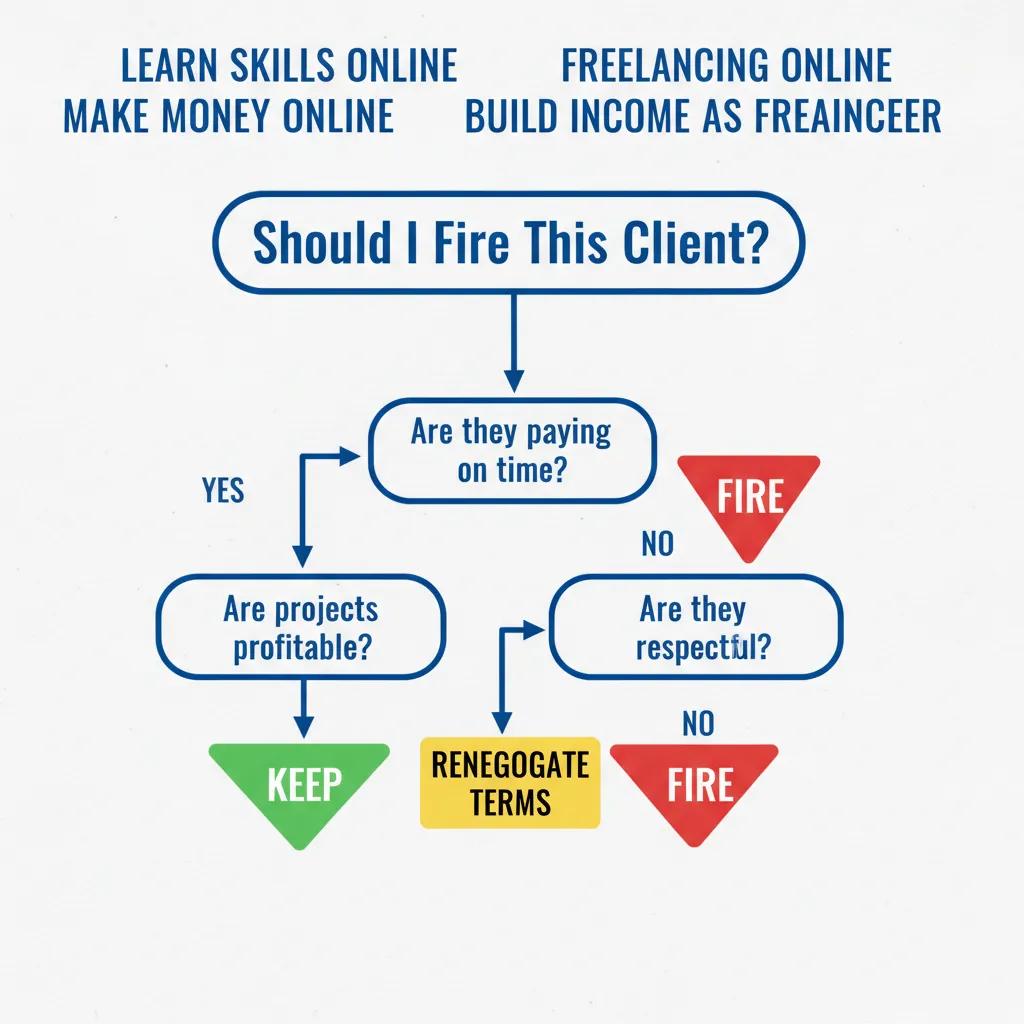
Sometimes, the money isn't worth the mental toll. Identifying the "Point of No Return" is crucial. If a client is abusive, demands illegal/unethical work, or consistently pays late, it is time to fire them.
Miles Everson, CEO of MBO Partners, noted in a 2024 report that the independent workforce is a "seismic shift" where talent chooses flexibility. You have the power to choose.
The Amicable Breakup Script
You don't need to list their faults. Frame it as a business shift.
I’m writing to let you know that due to a shift in my business direction/capacity, I won’t be able to continue with our contract effective [Date].
I want to ensure a smooth transition, so I will complete [Current Task] and hand over all files by [Date]. I can also recommend a few other freelancers who might be a great fit for your future needs.
Thank you for the opportunity to work together."
This burns zero bridges. It is professional, firm, and final.
2025 Market Trends: AI and the New Client Dynamics
We cannot discuss difficult clients in 2025 without mentioning Artificial Intelligence. A new breed of difficult client has emerged: the one who thinks AI makes your job instant.
Handling "AI Rates" for Human Work
You might hear: "Why does this cost $500? Can't you just use ChatGPT to write it in 5 minutes?"
This devaluation of labor is a major challenge. Upwork's Future Workforce Index (April 2025) shows that while skilled freelancers generated $1.5 trillion in earnings, the gap between "commodity" work and "expert" work is widening.
Your Counter-Argument: Explain that they are paying for strategy, liability, and nuance, not just word count or pixels. AI generates output; you generate results. If they want AI quality, they can use AI. If they want human expertise, they pay human rates.
FAQ: Handling Difficult Freelance Situations
How do I tell a client I'm raising my rates?
Give them 30 days' notice. Frame it around value. "Due to increased demand and the expanded value I'm providing (new certifications, faster tools), my rates will be increasing to X effective [Date]."
Can a freelancer sue for non-payment?
Yes. You can sue in Small Claims Court for breach of contract. Ensure you have a signed agreement and proof of work delivered.
What are the signs of a toxic freelance client?
Look for poor communication, disparaging previous freelancers, refusing to sign contracts, and asking for free "test" work.
How many revisions are standard in a freelance contract?
Two rounds of revisions are the industry standard. This encourages clients to be specific with their feedback.
Should I charge a kill fee for cancelled projects?
Absolutely. A kill fee protects you from lost time that you could have booked with other paying clients.
Is it okay to ghost a difficult client?
No. It damages your professional reputation. Always send a termination email, even if brief. Be the professional in the room.
Final Thoughts
Handling difficult freelance clients is a rite of passage. It transforms you from a gig worker into a business owner. Remember, every time you enforce a boundary, you aren't just protecting yourself—you are training the market to respect the $1.5 trillion freelance economy.
Alex Cattoni, founder of Copy Posse, put it best in 2024: "Enter into your client relationships with a contract." It’s simple, but it changes everything. Stand your ground, use the scripts provided above, and remember that saying "no" to a bad client is saying "yes" to a better one.
