

12 Best Passive Income Ideas for Freelancers to Scale in 2025
We need to talk about the “freelance ceiling.”
You know the one I’m talking about. It’s that invisible barrier where you realize you have maxed out your hourly rate, you are working weekends, and if you take a week off for the flu, your income drops to zero. In my decade of working independently, I’ve seen brilliant creators burn out not because they lacked skill, but because they were trapped in the “hours-for-dollars” cycle.
Here is the reality: The freelance economy is booming. According to the Upwork Research Institute, skilled freelancers fueled the U.S. economy by earning a staggering $1.5 trillion in 2024. But here is the catch—65% of those freelancers are still strictly trading time for money.
If you want to be part of the high-earning elite in 2025, you have to stop thinking like a gig worker and start thinking like an asset owner.
In this guide, I am going to walk you through the best passive income ideas for freelancers—whether you are a designer, developer, or writer—and show you how to build a safety net that pays you while you sleep.

Why Passive Income is Mandatory for the 2025 Freelance Economy
A few years ago, passive income was a nice “bonus.” Today, I believe it is a survival mechanism. The landscape of work has shifted fundamentally. We aren’t just competing with other freelancers anymore; we are competing with automated systems, AI, and a global marketplace that never sleeps.
The data supports this shift toward financial diversification. According to a September 2025 report by MBO Partners, the number of full-time independent workers earning over $100,000 grew to 5.6 million in 2025. How are they doing it? They aren’t working 25 hours a day. They are diversifying.
“The traditional 9-to-5 model is rapidly losing its grip as skilled talent chooses flexibility, financial control, and meaningful work.”
— Kelly Monahan, Managing Director, Upwork Research Institute
When you build passive income streams, you are essentially cloning yourself. You are creating digital versions of your expertise that can serve hundreds of clients simultaneously without requiring your active presence.
Top Passive Income Streams for Creative Freelancers (Design & Copy)
If you are a graphic designer, illustrator, or copywriter, you are sitting on a goldmine of intellectual property. The files you create for clients—the “discarded” concepts, the layout structures, the color palettes—are the raw materials for passive income.
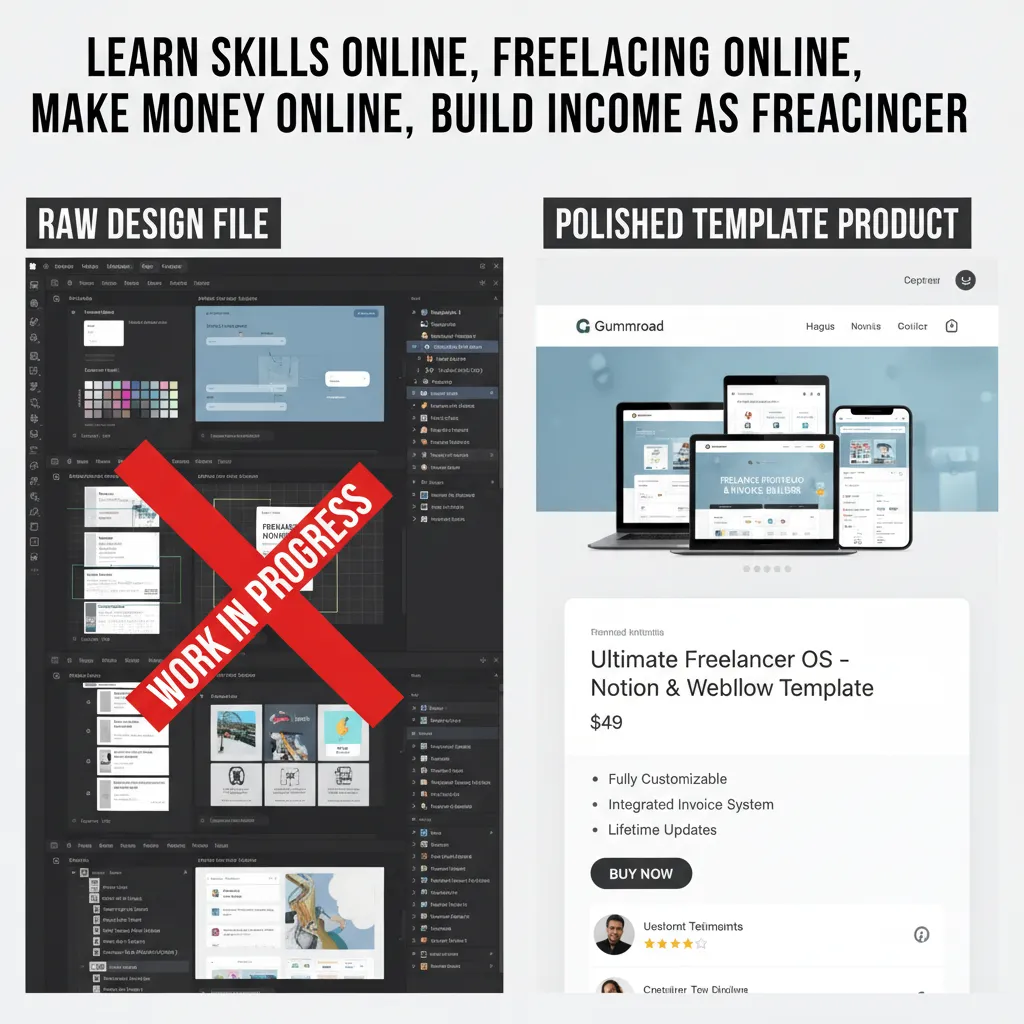
1. Selling “Productized” Templates
The demand for high-quality templates has exploded. Business owners don’t want to hire a designer for every Instagram post; they want a system they can use themselves. This is where you come in.
You can sell:
- Notion Systems: Project management dashboards or content calendars.
- Canva Kits: Social media brand packs for realtors or coaches.
- Figma UI Kits: Wireframe libraries for app developers.
Data from Hostinger indicates that interest in selling digital products increased by 75% going into 2025. I’ve seen designers who used to charge $500 for a logo now making $2,000 a month selling brand guideline templates on platforms like Creative Market or Gumroad.
2. Stock Licensing for Visual & Audio Assets
Stock photography isn’t dead; it has just evolved. The market is hungry for authentic, “non-stocky” content. If you are a photographer or videographer, uploading your B-roll and unused shots to sites like Shutterstock or Adobe Stock is the classic passive play.
But don’t ignore audio. With the rise of podcasting and YouTube, short audio stingers and background tracks are in high demand. It’s a numbers game, but once the assets are up, the maintenance is zero.
Passive Income for Technical Freelancers (Dev & Data)
Developers often think passive income means building the next Facebook. It doesn’t. It means building tiny, helpful tools that solve specific problems.
3. Building “Micro-SaaS” or AI Chrome Extensions
You have the coding skills that 99% of the population lacks. Instead of building a massive platform, build a “Micro-SaaS” (Software as a Service) that does one thing perfectly.
For example, a Chrome extension that helps recruiters format resumes, or a plugin that organizes Trello boards. With the efficiency of AI, building these tools is faster than ever. According to Staffing Industry Analysts, 74% of independent workers are using generative AI in 2025. You can use AI to accelerate your coding process, effectively reducing the “cost” of building these assets.
4. Selling Code Snippets and API Connectors
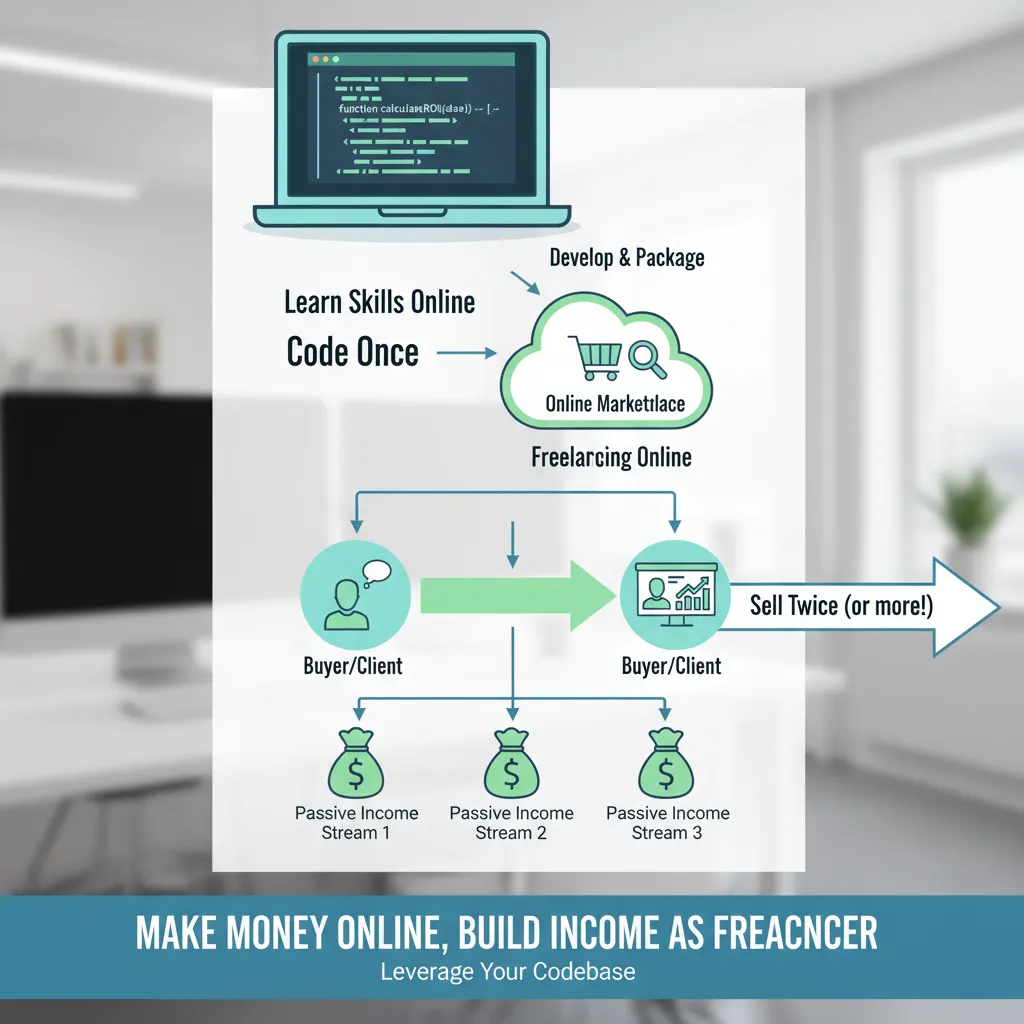
How many times have you written the same authentication script or API wrapper? Package it. Marketplaces like CodeCanyon allow you to sell scripts, plugins, and mobile app templates.
Case studies from Ruul.io in 2025 highlight developers earning a consistent $500–$5,000 per month simply by selling “Portfolio Automation” tools and niche API connectors. You write the code once, update it occasionally, and sell it indefinitely.
Content-Based Revenue: The “Expertise Flywheel”
As a freelancer, you are an expert. You know things your clients don’t. That knowledge gap is monetizable.
5. High-Ticket Niche Newsletters
I know what you’re thinking: “Not another newsletter.” but hear me out. The money isn’t in general news; it’s in deep, vertical-specific advice.
Platforms like Substack or Beehiiv allow you to charge a subscription for premium content. If you are a freelance CFO, write a newsletter about financial modeling for startups. If you are a legal consultant, write about IP law for creators. You only need a few hundred subscribers at $10/month to create a significant income stream.
6. Automated “Mini-Courses”
The era of the $2,000, 40-hour masterclass is fading. People want quick wins. “Mini-courses” that solve a specific problem in 90 minutes are the new standard.
Marguerita Cheng, CEO of Blue Ocean Global Wealth, noted in a 2025 Investopedia update: “I think there are more prospects than ever for people to create passive income—from creating courses to writing e-books to affiliate marketing.”
My advice: Don’t teach “Graphic Design.” Teach “How to Design a High-Converting Landing Page in Figma.” Specificity sells.
The Scaling Strategy: Turning Services into a Passive Agency
This is the advanced class. This is where you stop doing the work and start owning the system.
7. The “Drop-Service” Agency Model
This involves selling a service (like blog writing or logo design) and outsourcing the fulfillment to other freelancers while you manage quality control and client relations. Eventually, you hire a project manager, and you remove yourself from the daily operations entirely.
Take Josh Burns (JoshBurnsTech), for example. By combining affiliate marketing with an agency model and YouTube revenue, he reported earning over $51,000 in a single month in late 2025. He isn’t writing every line of code or editing every video himself; he has built a system.
8. Affiliate Marketing (The Right Way)
Affiliate marketing often gets a bad rap, but for freelancers, it is incredibly organic. You already use hosting, CRM tools, project management software, and design tools. Why not get paid to recommend them?
According to Hostinger, the affiliate marketing industry is now valued at $18.5 billion. By adding a “Resources” page to your portfolio site or including tool recommendations in your client offboarding process, you can generate recurring commissions. It’s not “selling out” if you genuinely believe in the product.
Passive Income Reality Check
Freelancer Scale: Globally, there are between 154 million and 435 million freelancers (Mellow.io, 2025). The competition is high, but the 12% at the top are the ones building assets, not just grinding hours.
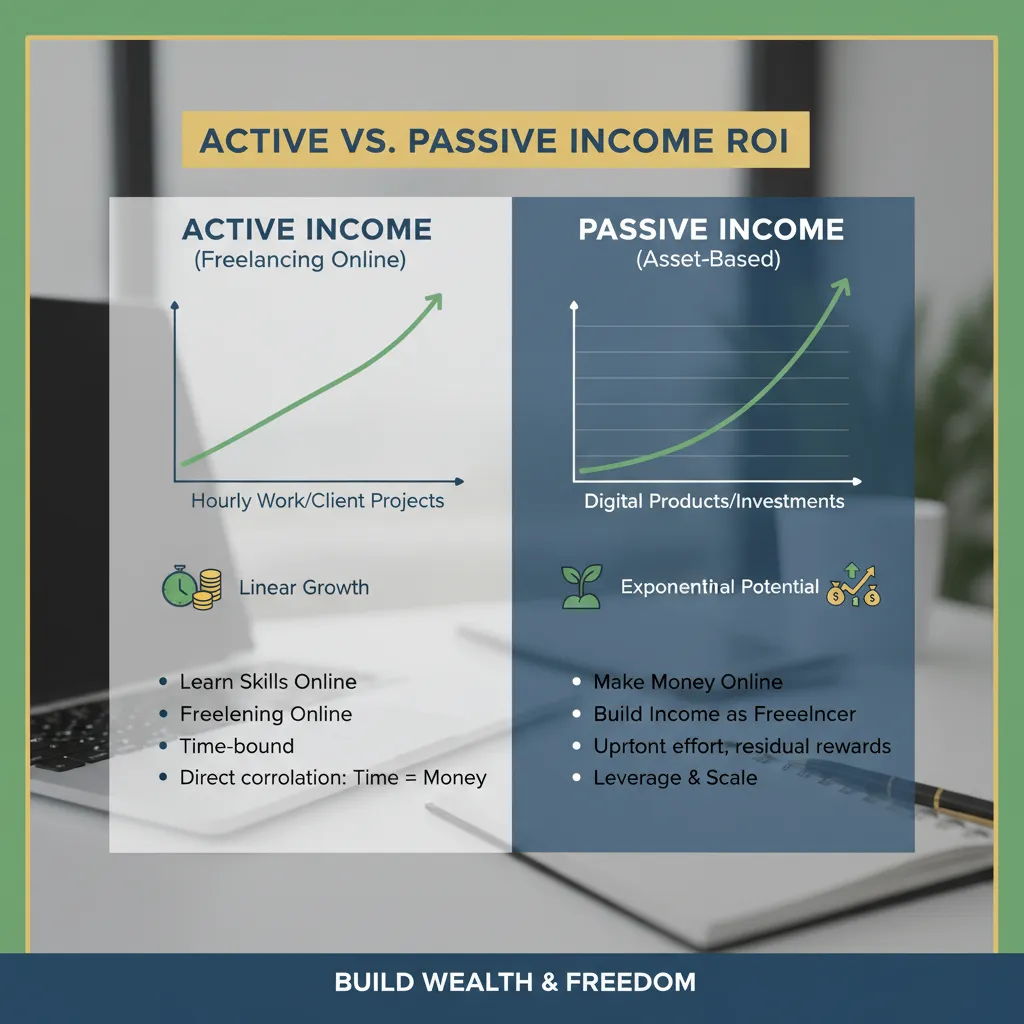
| Feature | Active Income (Service) | Passive Income (Assets) |
|---|---|---|
| Time Investment | Continuous (1:1 ratio) | Upfront heavy, minimal maintenance |
| Scalability | Capped by hours in the day | Unlimited (software/digital) |
| Client Interaction | High touch, demanding | Low touch, automated support |
| Income Stability | Volatile (Feast/Famine) | Consistent (Recurring/Long-tail) |
FAQ: Navigating Passive Income as a Freelancer
Yes. While “get rich quick” is a myth, realistic data shows freelancers earning an additional $500 to $5,000 per month within 12 months of launching a digital product. It requires treating the passive stream as a business, not a hobby.
Absolutely. The IRS views passive income (royalties, digital sales) as taxable. However, this income often qualifies for the Qualified Business Income (QBI) deduction if structured correctly within an LLC or S-Corp. Always consult a CPA.
Selling digital templates (Notion, Canva, or spreadsheets) is the lowest barrier to entry. You likely already have these files on your hard drive from previous client work. Clean them up, write instructions, and list them on Gumroad.
To a degree, yes. You can “productize” your services. Instead of offering custom consulting, offer a fixed-price “audit” generated by a tool you build. This moves you closer to passive income by drastically reducing the active time required per dollar earned.
Conclusion: Your 90-Day Roadmap
The transition from “active worker” to “asset owner” doesn’t happen overnight. It requires a shift in mindset. You have to stop undervaluing your intellectual property.
Here is what I want you to do: Look at your last five projects. identify the repetitive tasks you did for each one. Did you build a timeline? Design a mood board? Write a specific type of code? That repetitive task is your first product.
The freelance economy of 2025 rewards those who build leverage. As Miles Everson, CEO of MBO Partners, stated in their annual report, the growth of full-time independents signals a rejection of traditional employment structures in favor of financial control. Taking control means diversifying your income streams so you never have to panic during a slow month again.
Start small. Build one asset. Then build another. Your future self—the one earning money while on vacation—will thank you.
