

How to Learn Digital Marketing Skills at Home (The 2025 Career Roadmap)
In 2024, global digital ad spend smashed through the ceiling, exceeding $730 billion. That is a staggering amount of money flowing through the internet every single day. Yet, despite this massive influx of cash, companies are facing what industry insiders call a “massive talent gap.”
I remember sitting at my kitchen table a few years ago, looking at the tuition costs for a marketing master’s degree—nearly $40,000—and wondering if there was a better way. I realized something that changed my career trajectory: In this industry, nobody cares where you learned; they only care about what you can build.
You don’t need a university degree to secure a high-paying career in this field. You need a reliable Wi-Fi connection, a laptop, and a strategic blueprint. According to the U.S. Bureau of Labor Statistics (2024), marketing manager roles are projected to grow 10% from 2023 to 2033, which is faster than the average for all occupations. The demand is there. The question is, are you ready to meet it?
This isn’t just another list of courses. This is a data-backed, step-by-step guide to learning digital marketing at home, building a portfolio that demands attention, and landing clients or a job in 2025.
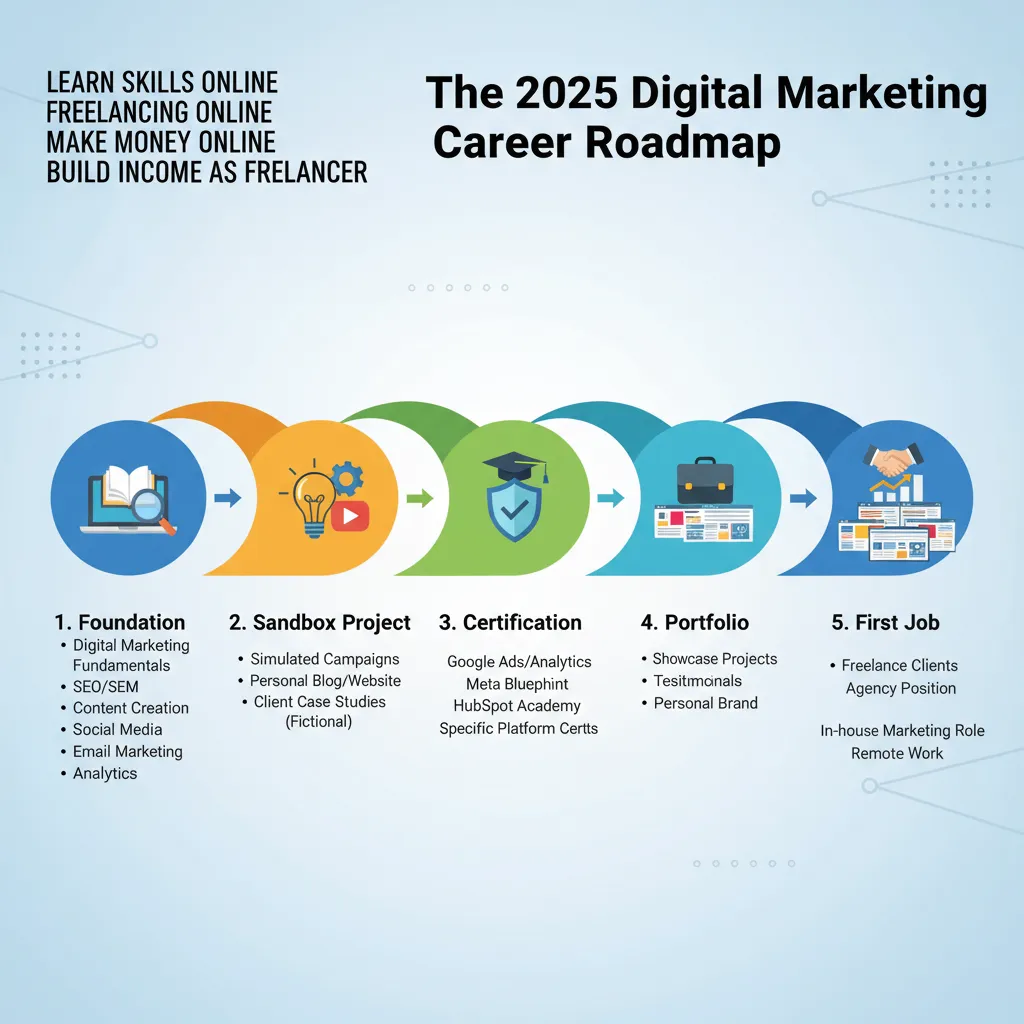
The 2025 Skill Stack: What You Actually Need to Master
Marketing has changed. If you’re reading guides from 2022, you’re already behind. The rise of AI and privacy changes has shifted the landscape. Here is the modern “Skill Stack” required to compete.
1. Search Everywhere Optimization (Not Just Google)
We used to call it SEO. Now, I like to think of it as “Search Everywhere Optimization.” While Google is still king, users are searching on TikTok, YouTube, and Amazon. But the biggest disruptor? AI Search.
According to Addison Group’s 2025 Hiring Trends (2024), candidates with AI-specific marketing skills can earn up to 25% more than those without. Learning how to optimize content so it gets picked up by Large Language Models (LLMs) like ChatGPT and Gemini is the new frontier.
2. Content Strategy & Humanized Storytelling
In a world flooded with AI-generated text, human creativity has become a premium asset. However, you shouldn’t ignore AI tools; you should master them to augment your workflow.
A 2024 report from HubSpot found that 84% of AI-using marketers produce content faster, saving an average of 2.5 hours daily. The goal isn’t to let AI write for you; it’s to use AI for research and outlining so you can focus on the “human” element—storytelling and empathy.
“Content is the atomic particle of all digital marketing.”
— Rebecca Lieb, Strategic Advisor
3. Performance Marketing (Ads & Analytics)
Organic traffic is great, but paid traffic scales. Understanding PPC (Pay-Per-Click) is crucial. According to WordStream (2025), PPC returns an average of $2 for every $1 spent—a 200% ROI. Mastering platforms like Meta Advantage+ and Google Smart Bidding is essential for managing budgets effectively.
The “Self-Taught” Blueprint: 5 Steps to Mastery
Most people fail because they watch YouTube videos for six months but never actually do anything. Here is the practical sandbox method I used, and that I recommend to everyone asking how to start.
Step 1: Understand the Digital Sales Funnel
Before you touch a tool, you must understand the psychology of the sale. You need to know how a stranger becomes a customer. As Rand Fishkin from SparkToro put it in a 2025 update: “Best way to sell something: don’t sell anything. Earn the awareness, respect, and trust of those who might buy.”
Step 2: The “Sandbox” Project (Critical Step)
This is where 90% of beginners stop, and it’s why they don’t get hired. You cannot learn digital marketing deeply without a website to break. You need a “sandbox”—a safe place to experiment.
Your Action Plan:
- Buy a domain ($12/year): Pick a hobby you love (e.g., “BestHikingBoots.com” or “VeganMealPrep.net”).
- Install WordPress: Don’t use Wix or Squarespace initially. Most jobs require WordPress knowledge.
- Set up Google Analytics 4 (GA4): This is the industry standard for data.
I’ve seen firsthand how interviewers’ eyes light up when a candidate pulls up their own live website data instead of showing a generic certificate.
Step 3: Certification Strategy
Not all certificates are created equal. In my opinion, you should prioritize “High-Weight” credentials that employers actually recognize.
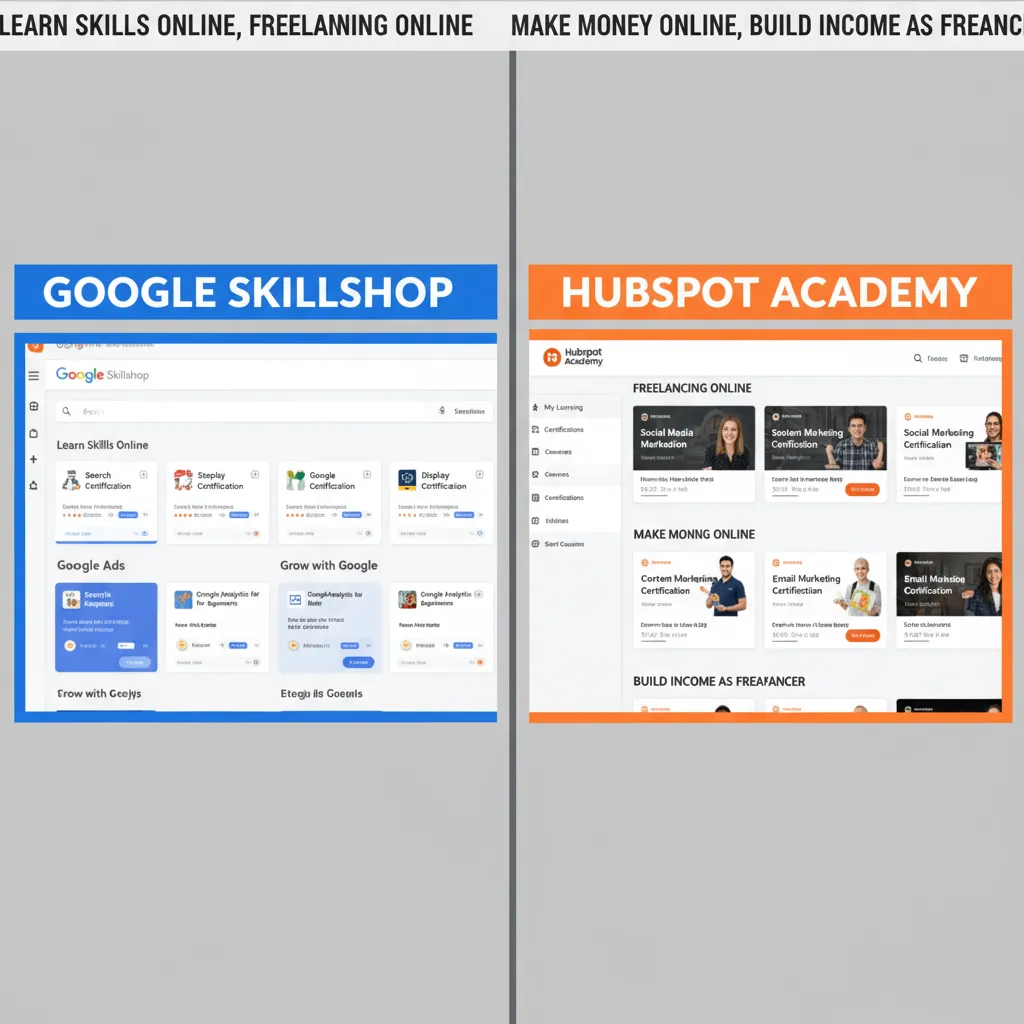
- Google Skillshop: Essential for Google Ads and GA4 mastery. It’s dry, technical, and absolutely necessary.
- HubSpot Academy: excellent for Inbound Marketing, Email Marketing, and Social Media Strategy. Their content is engaging and widely respected.
Step 4: AI & Data Literacy
You don’t need to be a mathematician, but you do need to understand basic data trends. According to HubSpot/Statista (2024), video now accounts for over 82% of all online traffic. Are you analyzing video retention rates? Are you using LLMs to analyze your spreadsheet data? These are the skills of 2025.
Best Free Platforms for Home Learning
You can spend thousands on bootcamps, or you can utilize these high-quality free resources. Here is my honest assessment of the top platforms.
1. HubSpot Academy
Best for: Beginners, Content Strategy, Email Marketing.
Verdict: This is where I started. The production quality is high, and the certifications are free. It focuses on the “Inbound” methodology—attracting customers rather than interrupting them.
2. Google Skillshop
Best for: Technical Skills, Ads, Analytics.
Verdict: It’s harder than HubSpot. The exams can be tricky. But having a “Google Ads Search Certification” on your LinkedIn profile is a non-negotiable trust signal for many agencies.
3. Coursera (Financial Aid Option)
Best for: Structured University-style learning.
Verdict: While not always free, they offer the “Google Digital Marketing & E-commerce Certificate.” You can apply for financial aid to get it for free. It’s comprehensive and covers the full spectrum from SEO to email.
Career Transition: From Self-Taught to Six-Figures
So, you’ve learned the skills. How do you actually get paid? This is the scary part for most people, but the data is encouraging.
Real-World Success: The Portfolio Method
Take the case of Mark R., a former teacher referenced in a 2025 Alifbyte report. At age 35, he transitioned to a Content Marketing Manager role not by showing his teaching degree, but by showing a blog he grew to 10,000 monthly visitors. Similarly, a Reddit user (Saransh_98sha) shared on the r/DigitalMarketing (2024) community that they landed an executive role after just 3 months of practicing on a personal project. The pattern is clear: Proof beats prestige.
Freelance vs. Agency vs. In-House
- Agency: High stress, high learning. You’ll handle 10+ clients at once. It’s the “bootcamp” of careers.
- In-House: You work for one brand. Better work-life balance, but slower skill acquisition.
- Freelance: High freedom, but you must be good at sales. I recommend starting freelance on the side while you learn.
According to WordStream (May 2025), the global digital advertising and marketing market is projected to reach $786.2 billion by 2026. There is enough slice of the pie for everyone, provided you have the skills to grab it.
Frequently Asked Questions (FAQ)
1. Can I really teach myself digital marketing?
Absolutely. The industry changes so fast that universities often struggle to keep their curriculum updated. Self-taught marketers who use “Sandboxes” (practice websites) often outperform graduates because they have practical experience.
2. How long does it take to learn digital marketing at home?
For a basic proficiency, expect to spend 3 to 6 months of consistent study (10-15 hours a week). To reach a hireable “Junior” level, you generally need to complete one or two major projects, which might take 6 months.
3. Do I need to be good at math?
You need basic arithmetic and an understanding of statistics (percentages, growth rates). You don’t need calculus. Tools like Google Analytics 4 do the heavy lifting; you just need to interpret the story the numbers are telling.
4. Is SEO dead in the age of AI?
No, but it is evolving. “10 blue links” are becoming less important, while appearing in AI summaries (ChatGPT, Gemini) is becoming crucial. This is being called “Answer Engine Optimization” (AEO).
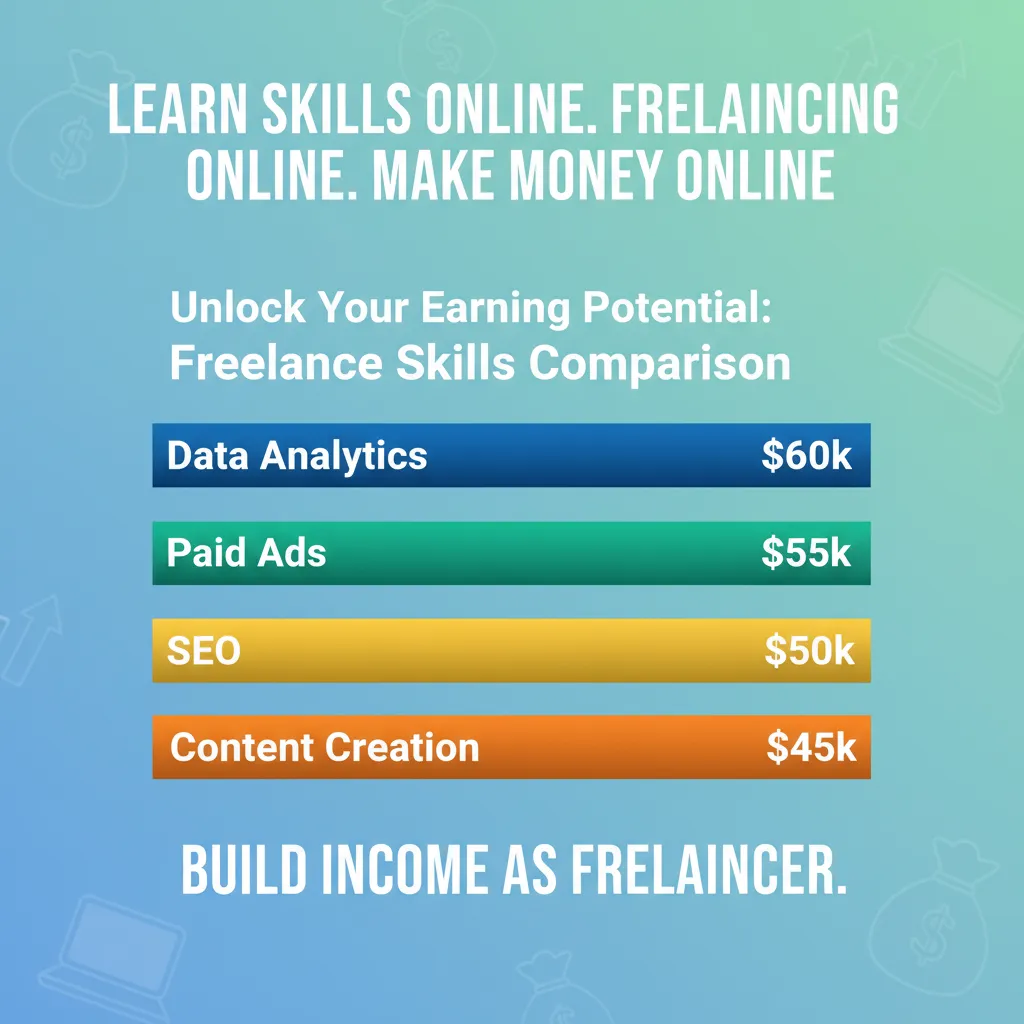
5. What is the highest-paying digital marketing skill?
Currently, data analysis (marketing science) and advanced paid media buying (PPC) command the highest salaries because they are directly tied to revenue. AI implementation is quickly rising to the top as well.
6. Can I get a job without a degree?
Yes. Employers in 2025 prioritize portfolios and certifications (like Google/HubSpot) over traditional degrees. A portfolio showing you managed $500 in ad spend and generated sales is worth more than a 4-year theory degree to most agencies.
Conclusion: Your Move
Learning digital marketing skills at home is not just about saving money on tuition; it’s about taking control of your financial future in a digital-first economy. The tools are free. The information is available. The demand for talent is growing at 10% per year according to the BLS.
However, I need to be honest with you: Reading this article won’t change anything. Building your first WordPress site, writing your first blog post, and running your first $10 ad campaign will.
Here is your checklist for the next 24 hours:
- Sign up for HubSpot Academy (it’s free).
- Purchase a domain name for your “Sandbox” project.
- Commit to learning one hour every evening.
The gap between where you are and where you want to be is simply the skills you haven’t learned yet. Start building your bridge today.
