

Can I Learn Graphic Design on My Own? The 2025 Ultimate Roadmap
I still remember the sinking feeling I had staring at the tuition bill for a design degree. It was astronomical. I asked myself the same question you’re asking right now: “Can I simply learn this myself?”
In 2025, the answer isn’t just “yes.” It is an emphatic “yes,” provided you have the discipline to ignore the noise and focus on what actually gets you hired.
Here is the reality check: The industry has shifted. According to a 2025 report by Upwork/Tapflare, 74% of executives now state that degrees are irrelevant when hiring creative talent—portfolios are the new currency. They don’t care about your diploma; they care about your ability to solve problems visually.
This article is your roadmap. We aren’t just talking about watching YouTube tutorials; we are going to break down the exact path to becoming a paid graphic designer without the $100,000 debt.
The global graphic design market value in 2025, projected to hit $81.3B by 2030 according to Mordor Intelligence. There is plenty of room for you.
The Reality Check: Is Self-Taught Actually Viable in 2025?
Let’s cut through the skepticism. You might worry that self-taught designers are viewed as “amateurs.” Years ago, that might have been true. Today, the data tells a different story.
The rise of the “demonstrated competence” economy means your work speaks louder than your pedigree. I’ve seen hiring managers toss resumes with Master’s degrees into the trash because the portfolio looked dated, while hiring a 20-year-old self-taught designer whose work showed a deep understanding of modern branding.
This shift is driven by necessity. The speed of design software updates—specifically the integration of AI—moves faster than university curriculums can change. According to the Adobe State of Creativity Report 2024, 82% of creatives are currently using Generative AI. By the time a university creates a syllabus on AI design, the technology has already evolved three times. You, as a self-learner, can pivot instantly.
Consider the case of Marvin Russell II, who documented his rise in late 2024 to agency leadership purely through portfolio demonstration. His success wasn’t an anomaly; it’s the new standard.
Phase 1: Mastering the Fundamentals (Before You Touch Software)
The biggest mistake I see beginners make is downloading Photoshop on day one. That’s like buying a hammer and thinking you can build a house without blueprints.
Design is 80% thinking and 20% execution. You need to train your eye before you train your hand.
The 5 Pillars of Visual Communication
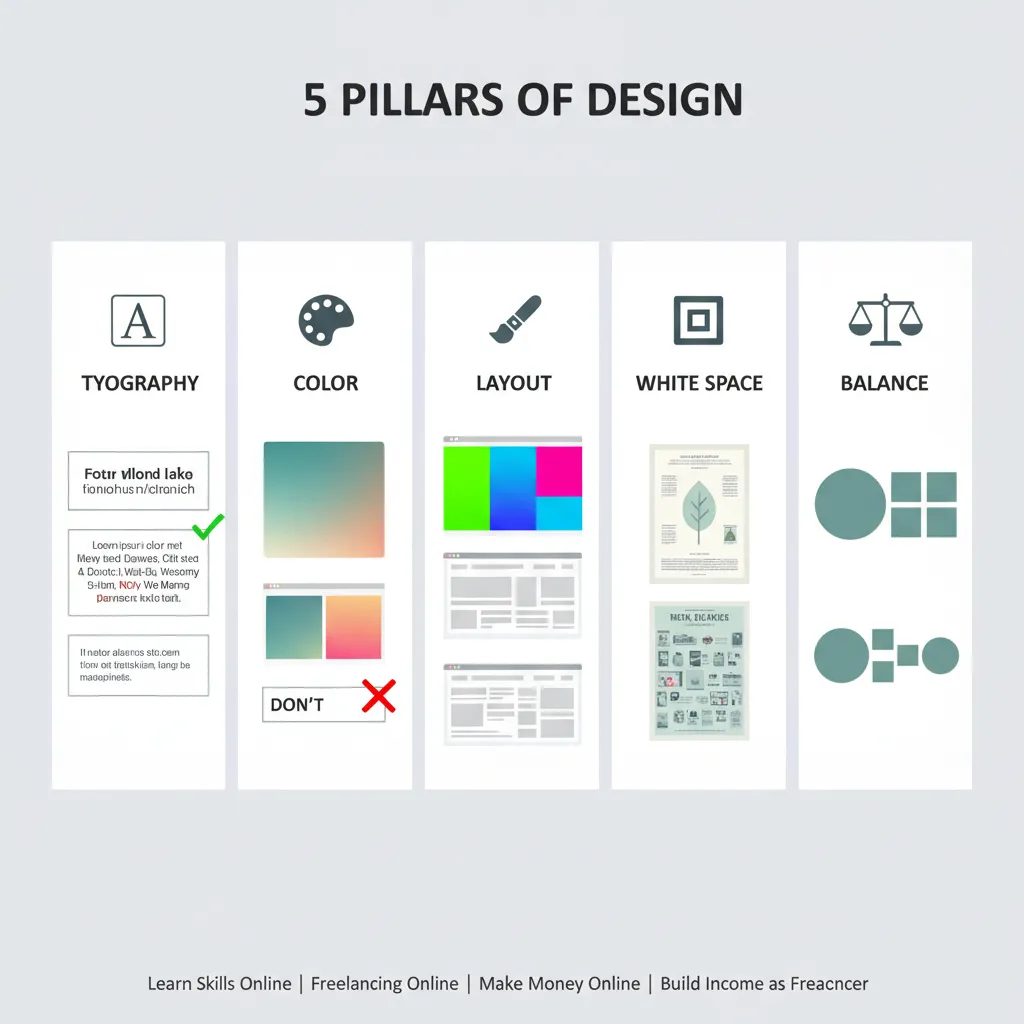
If you want to look like a pro, you must obsess over these five concepts:
- Typography: Understanding kerning, leading, and font pairing. Bad typography is the #1 giveaway of a self-taught amateur.
- Color Theory: It’s not just about what looks pretty; it’s about psychology and accessibility.
- Layout & Hierarchy: Guiding the viewer’s eye exactly where you want it to go.
- White Space: Learning that empty space is an active design element, not just “background.”
- Balance: Creating stability in your composition.
As Saul Bass famously said, “Design is thinking made visual” (referenced via Lemon8-app). If you can’t explain why you chose a specific color or layout, you aren’t designing; you’re decorating.
Phase 2: Building Your Technical Toolkit
Once you understand the “why,” you need the “how.” In 2025, the software landscape is dominated by a few key players. You don’t need to learn everything, but you do need to master the industry standards.
The Adobe Ecosystem vs. Figma
According to Exploding Topics (Dec 2024), Adobe software still commands over 80% of the creative market. However, the lines are blurring.
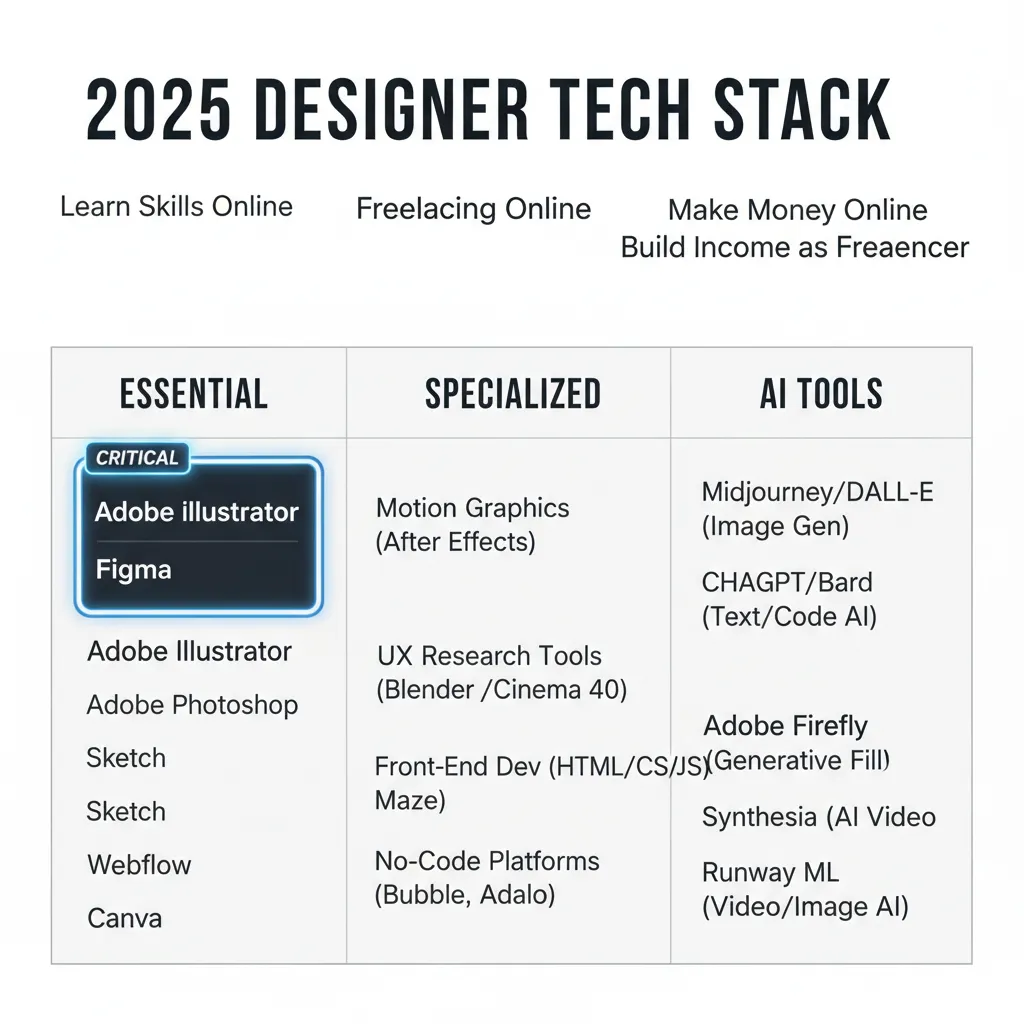
- Adobe Photoshop: Essential for photo manipulation and raster graphics.
- Adobe Illustrator: The gold standard for logos and vector graphics. If you want to do branding, you must learn this.
- Figma: Originally for UI/UX, Figma is now a non-negotiable skill for generalist designers. It’s collaborative, fast, and free for starters.
The AI Elephant in the Room
You cannot ignore Generative AI. Tools like Adobe Firefly and Midjourney are not replacing designers; they are replacing designers who don’t use AI. Demand for skills in emerging tech like AR/VR and AI integration is growing at a 15% CAGR according to Mordor Analysis (2025).
My advice: Learn to use AI for ideation and storyboarding. Let it generate 50 bad ideas so you can execute the one good one.
Phase 3: Building a “Hirable” Portfolio Without Clients
This is the Catch-22: You need a portfolio to get clients, but you need clients to build a portfolio. How do you break the loop?
You fake it. (Sort of).
You don’t need real clients to solve real problems. Use brief generators or redesign existing products. However, do not just post a pretty picture of a logo. That tells a hiring manager nothing.
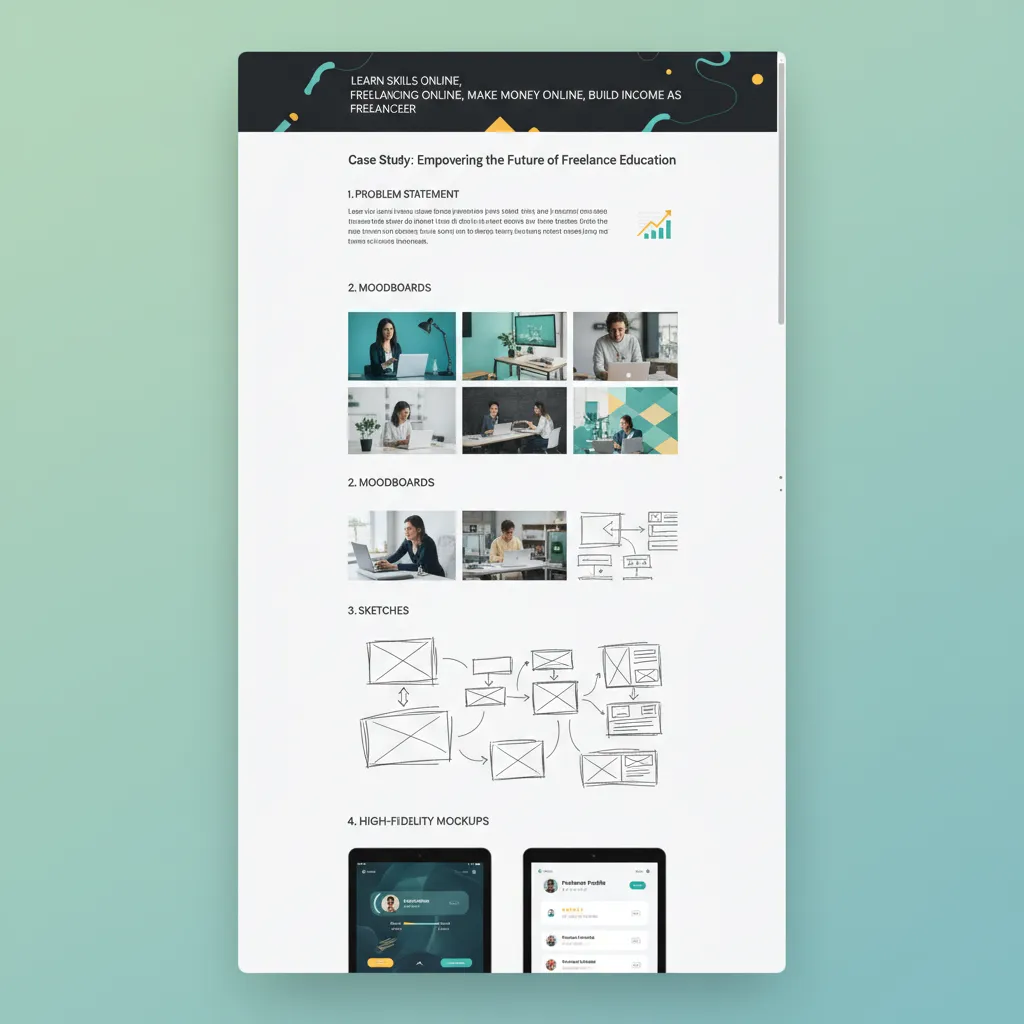
Case Study Architecture
A 2025 Designlab update highlighted Josie Allison, who transitioned into a high-level role by building detail-rich case studies. Your portfolio pieces should look like this:
- The Problem: “The local coffee shop has low brand recognition.”
- The Research: “I analyzed 5 competitors and found…”
- The Sketches: Show your messy napkin drawings. This proves you didn’t just steal the final design.
- The Solution: The final logo/website applied to mockups (business cards, signage).
- The Outcome: “This rebrand aims to increase foot traffic by…”
As Inkbot Design stated in June 2025: “Your portfolio is your passport. Your ability to solve business problems with design is your ultimate value.”
Phase 4: The Business of Design (Making Money)
Great design skills don’t automatically equal money. You need business acumen. Whether you want a job or freelance work, the 2025 market is specific.
The Salary Outlook
Is it worth it? The U.S. Bureau of Labor Statistics (2024) reports the median annual wage at $61,300, with the top 10% earning over $103,030. Interestingly, Skillademia (2025) notes that designer salaries grew by 2% in 2023, outpacing the general average.
Freelance vs. In-House
Freelancing offers freedom but requires you to be a salesperson, accountant, and project manager. In-house offers stability. A crucial trend from Robert Half (2024) shows that 59% of creative managers lost top candidates because they didn’t offer remote work options. If you are learning on your own, you are naturally positioned for remote roles because you have already demonstrated self-management.
Your 12-Month Action Plan
Months 1-3: The Theory Phase
Read “The Non-Designer’s Design Book.” Watch The Futur on YouTube. Learn the history of design. Do not open software yet.
Months 4-6: The Tool Phase
Pick one vector tool (Illustrator) and one raster tool (Photoshop). Follow tutorials but modify them—don’t just copy. Add your own twist.
Months 7-9: The Copycat Phase
Find designs you love and try to recreate them exactly. This trains your eye to see details you missed. (Do not publish these as your own work).
Months 10-12: The Portfolio Phase
Create 3 solid case studies. Build a website using Webflow or Adobe Portfolio. Start networking on LinkedIn.
Frequently Asked Questions
Yes. As noted earlier, 74% of hiring managers prioritize portfolios over degrees. Your work is your credential.
To reach an employable entry level, expect to dedicate 6 to 12 months of consistent study (15-20 hours a week). It is not an overnight process.
No. Graphic design is about composition, layout, and communication. Illustration is a separate skill. While helpful, drawing is not a requirement for most design roles.
You need a machine with a color-accurate screen, at least 16GB of RAM, and a decent processor. You do not strictly need a Mac, though they are industry standard. A powerful Windows PC works perfectly well.
Conclusion
Can you learn graphic design on your own? Absolutely. But let’s be real about what that requires. It requires the humility to suck at first, the patience to refine your craft, and the resilience to accept feedback.
The gatekeepers are gone. The tools are affordable. The knowledge is free. The only variable left in the equation is your effort.
Don’t wait for permission. Open a blank canvas today and start solving problems.
